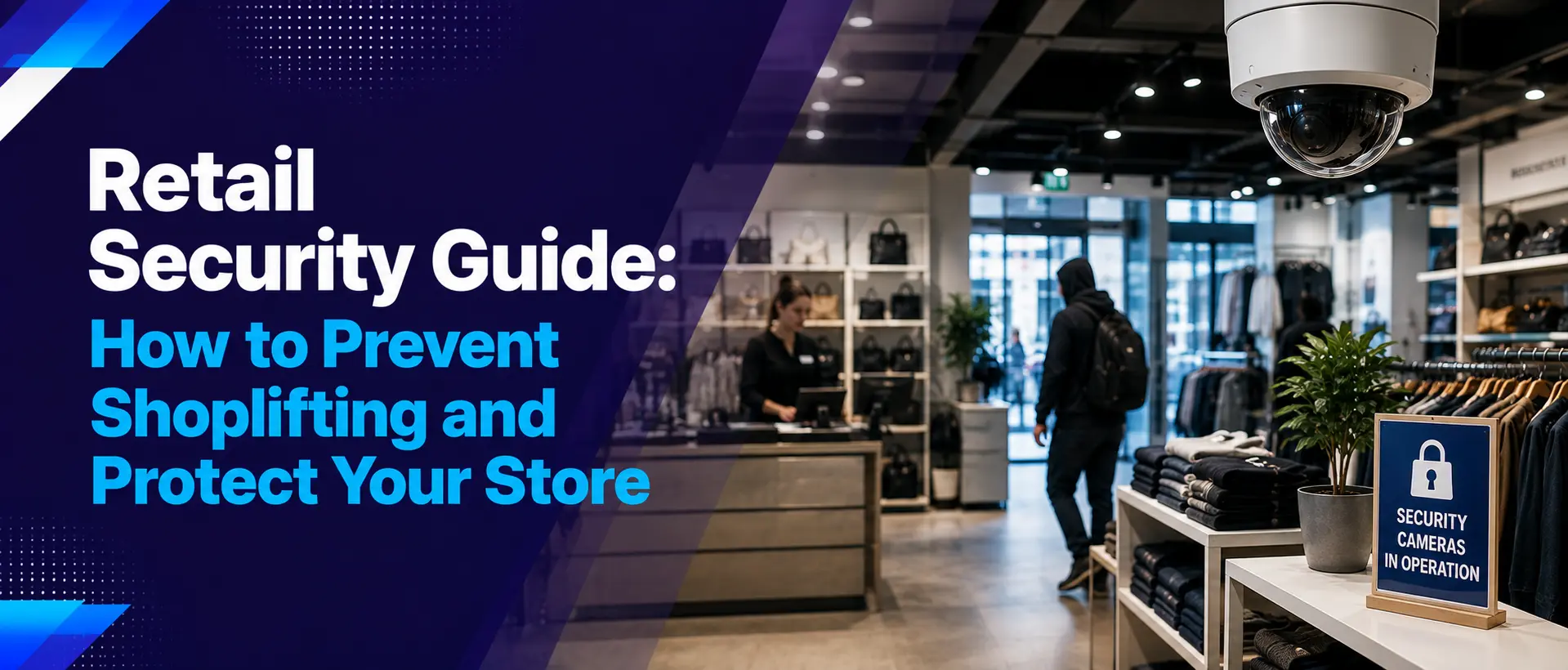
Retail businesses face a wide range of security challenges every day, from shoplifting and burglary to vandalism, aggressive behaviour, employee safety concerns and unauthorised access. A strong retail security strategy can help protect stock, premises, employees and customers while reducing the disruption caused by security incidents.
Modern retail security is no longer limited to a basic alarm or a camera above the entrance. Businesses can combine CCTV, AI-powered video analytics, intruder alarms, access control, security lighting and remote monitoring to create a layered security solution.
This guide explains the most effective retail security measures, how CCTV can help prevent and investigate shoplifting, what businesses should consider when protecting staff and stock, and how to build a practical security strategy for a retail store.
Why Is Retail Security Important?
Retail crime can have a direct impact on a business's profitability, staff wellbeing and day-to-day operations. Theft is only one part of the problem. Stores may also experience criminal damage, break-ins, aggressive behaviour, fraudulent activity and unauthorised access to staff-only areas.
The Information Commissioner's Office highlighted in July 2026 that retail businesses continue to deal with theft and violence against staff and that CCTV can be used as part of measures to protect businesses, staff and premises. :contentReference[oaicite:1]{index=1}
A good security system should therefore do more than record incidents after they happen. It should help deter unwanted behaviour, identify risks, provide useful evidence and support a faster response when an incident occurs.
A Strong Retail Security Strategy Can Help:
- Reduce opportunities for shoplifting.
- Protect valuable stock and equipment.
- Improve staff safety.
- Monitor entrances and exits.
- Protect stockrooms and restricted areas.
- Detect suspicious or unauthorised activity.
- Provide evidence following an incident.
- Improve security outside normal opening hours.
Common Security Risks for Retail Stores
Every retail environment is different, but most stores face a combination of predictable security risks.
1. Shoplifting
Shoplifting can affect businesses of all sizes. Small, high-value products can be particularly vulnerable because they may be easy to conceal or remove from the premises.
2. Burglary
Retail premises can become targets outside normal opening hours, particularly when valuable stock, cash or equipment is stored on site.
3. Employee Theft
Internal theft can be difficult to identify and requires businesses to balance legitimate security measures with appropriate employee privacy and data protection responsibilities.
4. Aggressive or Violent Behaviour
Retail staff can sometimes face aggressive behaviour from customers or offenders. Security measures such as CCTV can provide valuable evidence and may support wider staff safety procedures.
5. Unauthorised Access
Stockrooms, offices, cash-handling areas and other restricted spaces should not be accessible to everyone entering the store.
6. Vandalism
Criminal damage can create repair costs and disrupt normal trading. Visible security measures can also act as a deterrent.
7. Delivery and Stockroom Risks
Retail stores often have separate delivery entrances where goods and suppliers enter the premises. These areas require appropriate monitoring and access control.
How to Prevent Shoplifting in a Retail Store
No single security measure can eliminate shoplifting. The most effective approach combines store layout, employee procedures and appropriate security technology.
1. Use Visible CCTV
Clearly visible CCTV cameras can act as part of a deterrence strategy while also providing recorded evidence if an incident occurs.
Cameras should be positioned to provide useful coverage of entrances, exits, tills and other appropriate areas without unnecessarily capturing private spaces.
2. Protect High-Value Products
High-value or frequently stolen products can be positioned in areas with better staff visibility or protected using suitable physical security measures.
3. Improve Store Visibility
Shelving and displays should be arranged so that staff can maintain appropriate visibility across the sales floor.
4. Monitor Entrances and Exits
Entrances and exits are important areas for CCTV because they can help businesses understand who enters and leaves the premises and investigate incidents.
5. Train Staff
Employees should understand the store's security procedures, including how to report suspicious activity and what to do during an incident.
6. Secure Stockrooms
Stockrooms should be treated as restricted areas. Access should be limited to authorised employees where appropriate.
Retail CCTV Systems
CCTV is one of the most widely used security technologies in retail environments. A well-designed system can help deter crime, monitor activity and provide recorded evidence.
The effectiveness of a retail CCTV system depends heavily on camera positioning, image quality, lighting, recording settings and maintenance.
Important CCTV Locations
- Main entrances.
- Store exits.
- Checkout areas.
- High-value product areas.
- Stockrooms.
- Delivery entrances.
- Staff-only entrances.
- External areas.
- Car parks where applicable.
The aim should be to provide useful coverage of security-sensitive areas rather than simply installing as many cameras as possible.
For more information, see our Commercial CCTV Installation Guide .
AI-Powered CCTV for Retail Stores
Modern CCTV systems can provide intelligent video analytics that help retailers identify specific types of activity.
Depending on the equipment, AI-powered CCTV may support:
- Human detection.
- Vehicle detection.
- Intrusion detection.
- Line-crossing detection.
- Loitering detection.
- Intelligent event search.
- Smart alerts.
For example, an intelligent system may be configured to alert security personnel when a person enters a restricted area outside permitted hours.
AI does not automatically mean facial recognition. Many intelligent CCTV features analyse movement or objects without attempting to identify an individual.
Read our detailed article: AI-Powered CCTV Cameras: Smarter Security for Modern Businesses .
Can CCTV Help Prevent Shoplifting?
CCTV can contribute to shoplifting prevention in several ways.
Visible cameras may act as a deterrent, while recorded footage can help businesses investigate incidents and identify patterns.
However, CCTV should not be considered a complete replacement for good retail procedures. Store layout, employee awareness, stock management and appropriate physical security can all work alongside CCTV.
CCTV Can Help With:
- Monitoring entrances and exits.
- Reviewing incidents.
- Identifying vulnerable areas.
- Investigating suspected theft.
- Monitoring stockrooms.
- Supporting staff safety investigations.
- Providing evidence where appropriate.
Intruder Alarms for Retail Businesses
CCTV is particularly useful while a store is open, but an intruder alarm can provide an important additional layer of protection when the premises are closed.
Depending on the system, alarm protection can cover:
- External doors.
- Staff entrances.
- Windows.
- Stockrooms.
- Offices.
- Cash-handling areas.
- Restricted areas.
Modern alarm systems may also provide notifications or monitoring features depending on their configuration.
Regular maintenance is important to ensure alarm systems remain reliable.
See our Intruder Alarm Maintenance Checklist for UK Businesses for more information.
Access Control for Retail Stores
Not every person inside a retail business should have access to every area.
Access control can help restrict staff-only areas such as stockrooms, offices, server rooms, cash offices and other sensitive locations.
Access Control Options Can Include:
- Keypad systems.
- Proximity cards.
- Electronic locks.
- Smart access systems.
- Video door entry.
- Restricted user permissions.
Businesses should review access permissions when employees leave or change roles.
Protecting Retail Stockrooms and Back Offices
Stockrooms often contain a large proportion of a store's inventory, making them an important security area.
Security measures can include CCTV, access control, suitable locking systems and restricted employee access.
Stockroom Security Checklist
- Limit access to authorised employees.
- Install appropriate CCTV coverage.
- Secure external stockroom doors.
- Monitor delivery entrances.
- Review access permissions.
- Keep valuable items appropriately secured.
- Investigate unexplained stock discrepancies.
Retail Staff Safety and Security
Security is not only about protecting merchandise. Retailers also have a responsibility to consider the safety of employees working on the premises.
CCTV can help provide evidence following incidents involving aggressive behaviour, threats or violence, while access control and alarm systems can help protect staff-only areas.
Employees should know:
- How to report security incidents.
- Who to contact during an emergency.
- How to operate security systems relevant to their role.
- What to do if an alarm activates.
- How to report suspicious behaviour.
Security technology should support staff procedures rather than replace appropriate training and risk management.
Security During Opening and Closing Hours
Opening and closing periods can present different security risks because fewer people may be present and staff may be moving between the store and external areas.
Opening Checklist
- Check for signs of forced entry.
- Check external doors and windows.
- Review alarm status.
- Check CCTV is operational.
- Report suspicious damage or activity.
Closing Checklist
- Secure external doors.
- Check stockrooms and restricted areas.
- Secure valuable stock where appropriate.
- Arm the intruder alarm.
- Confirm CCTV is recording.
- Check staff-only entrances.
- Secure cash-handling areas.
Remote CCTV Monitoring for Retail
Remote monitoring can provide an additional layer of protection when a store is closed or when there are no security personnel physically present.
Depending on the service and system configuration, relevant security events can be assessed remotely and escalated according to agreed procedures.
Remote monitoring can be particularly useful for:
- Stores with valuable stock.
- Multiple retail locations.
- Out-of-hours security.
- High-risk premises.
- Remote or isolated stores.
Security Lighting for Retail Stores
Lighting can improve visibility around entrances, exits, car parks, loading areas and other external locations.
Appropriate lighting can also support CCTV performance by providing better visibility in low-light conditions.
Lighting should be positioned carefully so that it does not create glare or unnecessarily illuminate areas outside the intended security zone.
Retail Security Checklist
| Security Area | What to Check |
|---|---|
| CCTV | Check camera coverage, image quality, recording and vulnerable areas. |
| Entrances | Monitor main entrances, exits and staff access points. |
| Stockroom | Restrict access and maintain appropriate CCTV coverage. |
| Intruder Alarm | Check alarm zones, sensors, batteries and system status. |
| Access Control | Review authorised users and remove unnecessary access. |
| Lighting | Check external entrances, loading areas and other vulnerable locations. |
| High-Value Stock | Review storage, visibility and additional protection requirements. |
| Staff Safety | Ensure employees understand security and incident procedures. |
| Remote Monitoring | Check alerts, connectivity and monitoring arrangements where applicable. |
| Maintenance | Schedule regular professional checks of security equipment. |
CCTV, GDPR and Privacy for Retail Businesses
Retailers using CCTV need to consider how surveillance affects customers, employees and other people captured by the system.
The ICO states that businesses using CCTV should consider privacy, lawful processing, transparency, security, retention and people's information rights. :contentReference[oaicite:2]{index=2}
Have a Clear Purpose
Businesses should be able to explain why CCTV is necessary and what security purpose it serves.
Position Cameras Carefully
Cameras should capture areas relevant to the security purpose rather than unnecessarily monitoring private spaces.
The ICO specifically highlights that areas such as toilets and changing rooms generally carry a heightened expectation of privacy and CCTV there is unlikely to be fair or proportionate. :contentReference[oaicite:3]{index=3}
Use Appropriate Signage
Customers and staff should be informed that CCTV is in operation and provided with appropriate information about its use.
Control Access to Footage
Only authorised people should have access to recorded footage, with appropriate security measures in place.
Set an Appropriate Retention Period
Businesses should establish how long footage needs to be retained for the identified purpose rather than storing recordings indefinitely.
Be Careful With Facial Recognition
Facial recognition is different from ordinary CCTV analytics. Where biometric data is processed to uniquely identify individuals, additional legal requirements and safeguards may apply. :contentReference[oaicite:4]{index=4}
Retailers should review current ICO guidance and obtain appropriate professional advice where necessary.
Common Retail Security Mistakes
Relying Only on CCTV
CCTV is valuable, but it should form part of a wider security strategy.
Ignoring Stockroom Security
Protecting the sales floor while leaving the stockroom poorly controlled can create a significant security weakness.
Using Poor Camera Positions
Even high-resolution cameras are of limited value if they are positioned incorrectly or affected by glare, poor lighting or obstructions.
Not Maintaining Security Equipment
Cameras, alarms and access control systems require regular testing and maintenance.
Ignoring Staff Training
Employees should understand what to do when they notice suspicious activity or a security system generates an alert.
Failing to Review Security After an Incident
A theft or security incident should be an opportunity to assess whether existing security measures need improvement.
When Should a Retail Store Upgrade Its Security?
A security upgrade may be appropriate when a store's risks have changed or the existing system no longer provides sufficient coverage.
Consider an Upgrade If:
- Your CCTV system produces poor-quality footage.
- There are blind spots around important areas.
- Your store has experienced repeated theft.
- Your intruder alarm is outdated.
- Access to restricted areas is difficult to control.
- Your business has expanded.
- You need remote monitoring.
- You want intelligent CCTV analytics.
- Your existing system is difficult to maintain.
Businesses should assess their actual security requirements before replacing equipment. In some cases, targeted upgrades may provide a better solution than replacing the entire system.
How Much Does Retail Security Cost?
There is no fixed price for retail security because requirements vary from one store to another.
Factors that can influence the cost include:
- Number of CCTV cameras.
- Camera resolution and analytics.
- Number of entrances.
- Intruder alarm requirements.
- Access control.
- Recording and storage requirements.
- Remote monitoring.
- Network infrastructure.
- Installation complexity.
- Ongoing maintenance.
A professional site survey can help identify the areas that need protection and prevent businesses from spending money on unnecessary equipment.
Choosing a Professional Retail Security Installer
The quality of the installation can have a major effect on how well a security system performs.
When selecting a security company, consider:
- Experience with commercial and retail security.
- CCTV design and installation experience.
- Intruder alarm expertise.
- Access control experience.
- AI CCTV and video analytics capabilities.
- Remote monitoring options.
- Maintenance and support services.
- Ability to integrate multiple security systems.
A professional installer should first understand the store, its layout, security risks and business requirements before recommending a system.
Why a Layered Retail Security System Works Best
Retail security works best when multiple measures support each other.
CCTV can provide visibility. AI analytics can help identify relevant events. Intruder alarms can protect the premises outside opening hours. Access control can restrict staff-only areas, while lighting and physical security can reduce opportunities for unwanted access.
A complete retail security strategy may therefore include:
- Commercial CCTV.
- AI-powered video analytics.
- Intruder alarms.
- Access control.
- Video door entry.
- Security lighting.
- Remote monitoring.
- Regular maintenance.
Protect Your Retail Store with Professional Security
Retail businesses need security systems that protect more than just products. A well-designed solution can help protect employees, customers, premises, stock and business operations.
Third Eye Security provides professional CCTV, intruder alarm, access control and integrated security solutions for businesses across the UK.
Whether you need to upgrade an existing CCTV system, improve shoplifting prevention or develop a complete security solution for a new retail premises, our team can assess your requirements and recommend a suitable approach.
Contact Third Eye Security today to discuss your retail security requirements.
Conclusion
Retail security requires a combination of technology, procedures and staff awareness. Shoplifting, burglary, vandalism, unauthorised access and staff safety concerns can all affect a store's operations and profitability.
CCTV remains an important part of retail security, but modern businesses can go further by combining traditional surveillance with AI analytics, intruder alarms, access control, security lighting and remote monitoring.
The most effective solution is one designed around the individual store. Camera positions, alarm zones, access permissions and monitoring requirements should all be based on the actual risks and layout of the premises.
Retailers should also consider privacy and data protection when using CCTV. The ICO provides specific guidance for organisations using CCTV and has highlighted the importance of responsible use of surveillance in retail environments. :contentReference[oaicite:5]{index=5}
With the right combination of security technology, professional installation and regular maintenance, retailers can create a safer and more secure environment for their staff, customers, stock and business.
If your retail store needs a CCTV, alarm or integrated security upgrade, contact Third Eye Security to discuss your requirements.