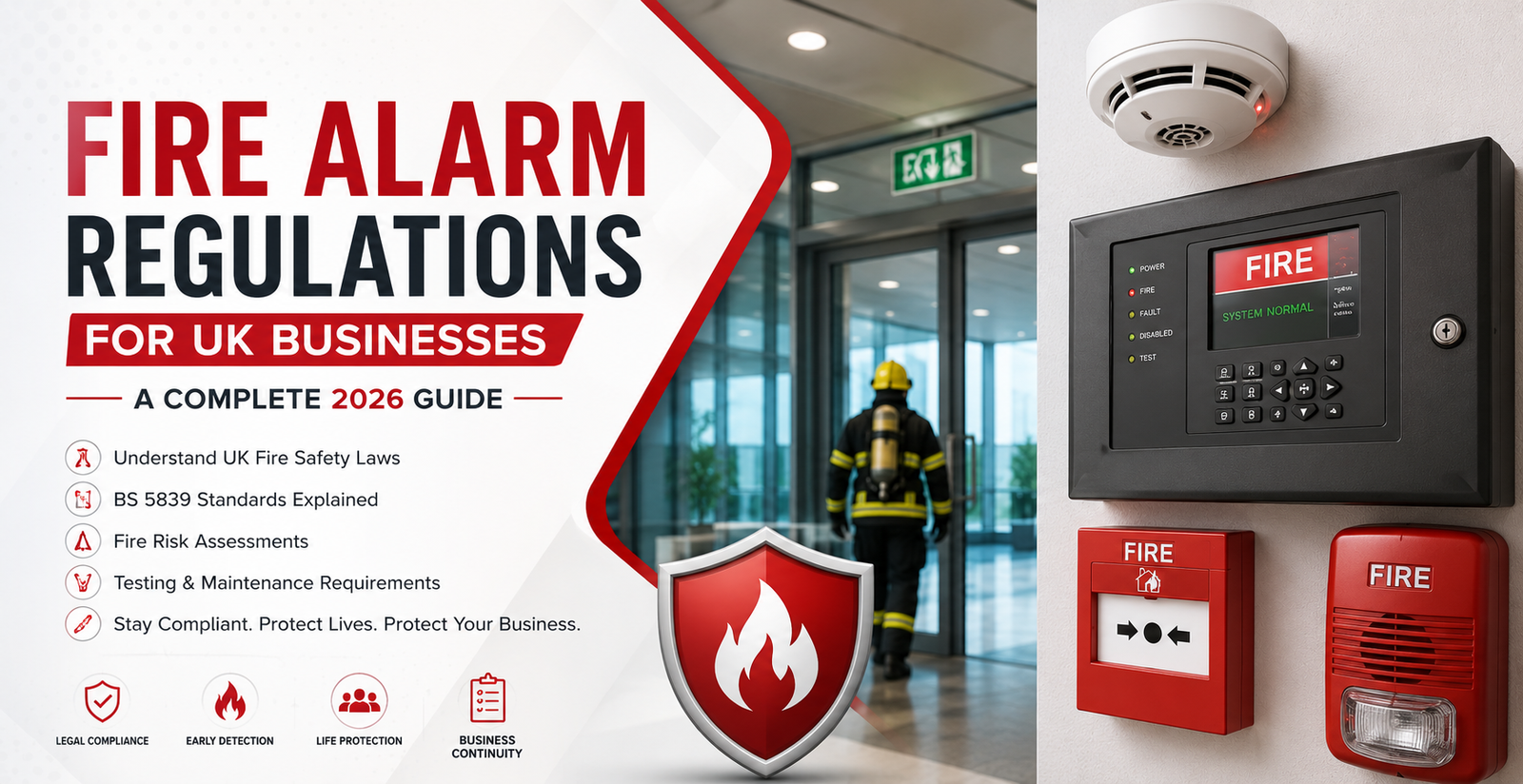
Fire Alarm Regulations for UK Businesses: A Complete 2026 Guide
Fire safety is one of the most important responsibilities for every business owner, employer and property manager in the United Kingdom. Whether you operate a small office, retail shop, restaurant, warehouse, healthcare facility or large commercial premises, protecting people from fire is not only a moral responsibility but also a legal requirement.
Modern fire alarm systems provide early warning, help occupants evacuate safely and significantly reduce the risk of serious injury, property damage and business interruption. However, simply installing a fire alarm isn't enough. UK businesses must also comply with fire safety legislation, maintain their systems correctly and ensure they remain fit for purpose throughout the year.
In this comprehensive guide, we'll explain the key UK fire alarm regulations, discuss the Regulatory Reform (Fire Safety) Order 2005, outline the role of BS 5839, explain testing and maintenance requirements and provide practical advice to help your business remain compliant in 2026 and beyond.
Table of Contents
- Why Fire Alarm Compliance Matters
- Understanding UK Fire Safety Laws
- The Regulatory Reform (Fire Safety) Order 2005
- Who Is the Responsible Person?
- Why Fire Risk Assessments Are Essential
- BS 5839 Explained
- Types of Commercial Fire Alarm Systems
- Fire Alarm Testing Requirements
- Maintenance Requirements
- Common Compliance Mistakes
- Penalties for Non-Compliance
- Choosing a Professional Fire Alarm Installer
- Frequently Asked Questions
Why Fire Alarm Compliance Matters
Every year, thousands of fires affect commercial properties across the UK. Even a relatively small incident can cause significant financial losses, prolonged business disruption and, most importantly, put lives at risk.
A properly designed and maintained fire alarm system provides occupants with valuable time to evacuate safely while enabling emergency services to respond quickly. It also helps businesses minimise damage, protect assets and demonstrate compliance with UK fire safety legislation.
Failing to comply with fire safety requirements may result in enforcement action, prosecution, substantial fines or, in serious cases, imprisonment for those responsible for fire safety management.
For this reason, fire alarm compliance should never be viewed as a simple box-ticking exercise. It is an essential part of responsible business management.
Understanding UK Fire Safety Laws
Unlike some areas of legislation, UK fire safety law focuses on a risk-based approach rather than prescribing identical requirements for every building.
This means businesses are expected to identify fire hazards, assess the risks and implement suitable fire protection measures based on the nature of their premises and activities.
Several pieces of legislation and recognised standards work together to establish best practice for commercial fire safety. Among these, the most significant is the Regulatory Reform (Fire Safety) Order 2005, which applies to virtually all non-domestic premises in England and Wales.
Supporting standards such as BS 5839 provide detailed recommendations for the design, installation, commissioning and maintenance of fire detection and fire alarm systems.
The Regulatory Reform (Fire Safety) Order 2005
The Regulatory Reform (Fire Safety) Order 2005 forms the foundation of fire safety legislation for most commercial premises in England and Wales.
Rather than specifying exactly what equipment every building must have, the legislation places responsibility on the person in control of the premises to ensure appropriate fire precautions are in place.
Key Responsibilities Include:
- Completing a suitable fire risk assessment.
- Identifying potential fire hazards.
- Providing appropriate fire detection and warning systems.
- Maintaining fire alarm equipment.
- Providing emergency escape routes.
- Ensuring staff receive fire safety training.
- Reviewing fire safety arrangements regularly.
The exact fire alarm system required depends on the findings of your fire risk assessment, the size and complexity of the building and the activities carried out within it.
Who Is the Responsible Person?
One of the most important concepts introduced by the Fire Safety Order is the role of the Responsible Person.
The Responsible Person is legally accountable for ensuring fire safety arrangements are suitable and maintained.
This may include:
- The business owner.
- An employer.
- A managing director.
- A facilities manager.
- A landlord or property manager.
- Any individual with control over part or all of the premises.
The Responsible Person must ensure appropriate fire precautions are implemented, reviewed and maintained at all times. This includes arranging regular inspections, keeping maintenance records and ensuring employees understand emergency procedures.
Although specialist contractors can install and maintain fire alarm systems, the legal responsibility for compliance always remains with the Responsible Person.
Why Fire Risk Assessments Are Essential
A fire alarm system should never be installed based on guesswork or simply because another business uses a similar setup. Every commercial property is different, which is why a comprehensive fire risk assessment is one of the most important steps in achieving compliance with UK fire safety legislation.
A fire risk assessment identifies potential fire hazards, evaluates who may be at risk and determines what fire protection measures are necessary to reduce those risks to an acceptable level.
Although smaller businesses may carry out their own assessments if they have the required competence, many organisations choose to appoint qualified fire safety professionals to ensure the assessment is accurate, practical and fully documented.
A Typical Fire Risk Assessment Includes:
- Identifying ignition sources.
- Assessing combustible materials.
- Reviewing existing fire detection systems.
- Evaluating emergency escape routes.
- Checking emergency lighting.
- Reviewing evacuation procedures.
- Assessing staff fire safety training.
- Identifying vulnerable occupants.
- Recommending improvements where necessary.
Fire risk assessments are not one-off exercises. They should be reviewed regularly and whenever there are significant changes to the building, occupancy or business operations.
Understanding BS 5839
One of the most frequently referenced standards in commercial fire safety is BS 5839. While it is not legislation itself, it is recognised throughout the UK as the benchmark for the design, installation, commissioning and maintenance of fire detection and fire alarm systems.
Compliance with BS 5839 demonstrates that a fire alarm system has been designed using recognised industry best practice.
The standard helps ensure fire alarm systems provide adequate protection while reducing the likelihood of false alarms and unnecessary disruption.
BS 5839 Covers:
- System design.
- Equipment selection.
- Detector positioning.
- Control panels.
- Manual call points.
- Alarm sound levels.
- Commissioning procedures.
- Routine servicing.
- Record keeping.
Businesses planning a new installation or upgrading an existing fire alarm system should always ensure that work is completed by competent professionals familiar with BS 5839 recommendations.
Fire Alarm Categories Explained
Fire alarm systems are designed according to different categories depending on the level of life protection or property protection required.
Category M – Manual Fire Alarm Systems
Category M systems rely entirely on manual call points. Occupants activate the alarm after discovering a fire.
These systems are generally unsuitable for many commercial premises unless supported by appropriate fire risk assessments.
Category L Systems (Life Protection)
Life protection systems are designed to protect building occupants.
Category L1
Automatic detectors are installed throughout the entire building, providing the highest level of life protection.
Category L2
Additional protection is provided in high-risk areas together with escape routes.
Category L3
Detection is focused on escape routes and rooms opening directly onto those routes.
Category L4
Detection is installed mainly along escape routes.
Category L5
A custom-designed system protecting specific identified risks.
Category P Systems (Property Protection)
Property protection systems focus on reducing damage to buildings and business assets.
Category P1
Automatic fire detection is installed throughout the premises to provide the highest level of property protection.
Category P2
Detection is limited to defined high-risk areas where fire could cause significant business interruption.
The appropriate category should always be determined through a professional fire risk assessment.
Which Businesses Need Fire Alarm Systems?
Most commercial premises require some form of fire detection and warning system. However, the type of system depends on several factors including occupancy levels, building layout, fire risks and legal obligations.
Businesses commonly requiring professionally designed fire alarm systems include:
- Office buildings.
- Retail shops.
- Restaurants and cafés.
- Warehouses.
- Hotels and guest accommodation.
- Schools and colleges.
- Healthcare facilities.
- Industrial units.
- Manufacturing plants.
- Apartment blocks with communal areas.
Each environment presents different fire risks, meaning the same fire alarm design is rarely suitable for every property.
Choosing the Right Fire Alarm System
Selecting the correct fire alarm system involves more than simply purchasing detectors and a control panel. A professionally designed solution considers your building layout, occupancy, operational requirements and future expansion plans.
When choosing a fire alarm system, consider:
- The size of the premises.
- The number of occupants.
- Business operating hours.
- High-risk processes or equipment.
- Insurance requirements.
- Integration with other security systems.
- Future business growth.
Many organisations now choose integrated life safety solutions that combine fire alarms, emergency lighting monitoring, access control integration and remote system notifications to improve both safety and operational efficiency.
Working with an experienced fire alarm installer ensures the recommended solution is appropriate for your premises and aligns with recognised industry standards.
Fire Alarm Testing Requirements
Installing a fire alarm system is only the first step. To remain effective, the system must be tested regularly to ensure it will operate correctly in the event of an emergency.
Routine testing helps identify faults before they become serious problems and demonstrates that your business is actively managing its fire safety responsibilities.
While the exact testing programme should be based on your fire risk assessment and the manufacturer's recommendations, many UK businesses follow a structured inspection schedule.
Recommended Fire Alarm Testing Schedule
| Frequency | Recommended Activity |
|---|---|
| Weekly | Test at least one manual call point and confirm the alarm can be heard throughout the building. |
| Monthly | Inspect standby batteries, power supplies and any automatic communication equipment. |
| Every Six Months | Arrange servicing by a competent fire alarm engineer who can inspect detectors, control equipment and system performance. |
| Annually | Carry out a comprehensive inspection, review fire safety documentation and verify the system remains suitable for the premises. |
Keeping a record of all inspections and tests is essential. Documentation may be requested during audits, insurance assessments or investigations following a fire-related incident.
Fire Alarm Maintenance Requirements
Like any life safety system, fire alarms require ongoing maintenance to remain reliable. Dust, environmental conditions, accidental damage and normal wear can affect the performance of detectors and control equipment over time.
Routine maintenance should include:
- Inspection of smoke and heat detectors.
- Testing manual call points.
- Checking sounders and visual warning devices.
- Inspecting the control and indicating equipment.
- Testing standby batteries.
- Checking power supplies.
- Verifying communication links.
- Reviewing event logs and fault history.
- Cleaning detectors where necessary.
- Updating maintenance records.
Planned preventive maintenance helps reduce unexpected faults, extends equipment life and ensures your fire alarm system continues to provide reliable protection.
Why Keeping a Fire Alarm Log Book Is Important
A fire alarm log book provides evidence that your business is carrying out regular testing, maintenance and inspections.
Typical records include:
- Weekly alarm tests.
- Maintenance visits.
- Fault reports.
- Repairs completed.
- False alarm investigations.
- Staff fire safety training.
- Changes to the fire alarm system.
Maintaining accurate records demonstrates a proactive approach to fire safety and can be invaluable during inspections or insurance claims.
Common Fire Alarm Compliance Mistakes
Even businesses that have installed modern fire alarm systems sometimes fall short because routine management is overlooked.
Some of the most common compliance issues include:
- Failing to carry out regular fire risk assessments.
- Ignoring fault warnings on the control panel.
- Not arranging routine servicing.
- Blocking smoke detectors or manual call points.
- Allowing escape routes to become obstructed.
- Not keeping maintenance records.
- Failing to train employees on evacuation procedures.
- Continuing to use outdated or damaged equipment.
These issues can reduce the effectiveness of your fire alarm system and increase the likelihood of enforcement action.
Potential Consequences of Non-Compliance
Failure to comply with fire safety legislation can have serious consequences for both businesses and responsible persons.
Depending on the circumstances, enforcement authorities may:
- Issue improvement notices.
- Serve prohibition notices restricting the use of premises.
- Prosecute businesses for serious breaches.
- Impose substantial financial penalties.
- Take legal action where negligence places lives at risk.
Beyond legal consequences, poor fire safety management can result in business interruption, reputational damage, increased insurance costs and, most importantly, significant risks to employees, customers and visitors.
Choosing a Professional Fire Alarm Installation Company
Selecting the right installer is essential to ensuring your fire alarm system is designed, installed and maintained to a high professional standard.
When comparing providers, look for a company that offers:
- Professional site surveys.
- Tailored system design.
- Experienced installation engineers.
- Routine maintenance and servicing.
- Emergency support.
- Clear documentation and certification.
- Ongoing technical advice.
An experienced installer will assess your building, discuss your operational requirements and recommend a solution that provides appropriate protection without unnecessary complexity or cost.
Protect Your Business with a Reliable Fire Alarm System
Whether you're installing a new fire alarm system, upgrading existing equipment or arranging routine maintenance, choosing the right solution is essential for protecting people, property and business continuity.
Third Eye Security provides professional fire alarm installation, maintenance and servicing for offices, retail premises, warehouses, schools, healthcare facilities and commercial properties across the UK.
Our experienced engineers can help you choose a system that meets your operational requirements and supports your ongoing fire safety strategy.
Contact Third Eye Security today to arrange a free consultation and discuss your fire alarm requirements.
Final Thoughts
Fire safety is an ongoing responsibility rather than a one-time project. Installing a compliant fire alarm system, carrying out regular testing, maintaining accurate records and reviewing your fire risk assessment all contribute to creating a safer working environment.
As your business grows or your premises change, your fire safety arrangements should evolve too. Regular reviews help ensure your system continues to provide the level of protection your employees, visitors and property deserve.
Working with an experienced fire alarm specialist gives you confidence that your system is professionally designed, properly maintained and capable of supporting your wider business continuity strategy.
Need Professional Fire Alarm Installation or Maintenance?
Whether you need a new commercial fire alarm system, routine servicing or expert advice on improving fire safety, Third Eye Security is here to help.
Our experienced engineers provide tailored fire alarm solutions for offices, retail stores, warehouses, schools, healthcare facilities and commercial buildings across the UK.
Contact us today to arrange a free consultation and discuss the right fire alarm solution for your business.