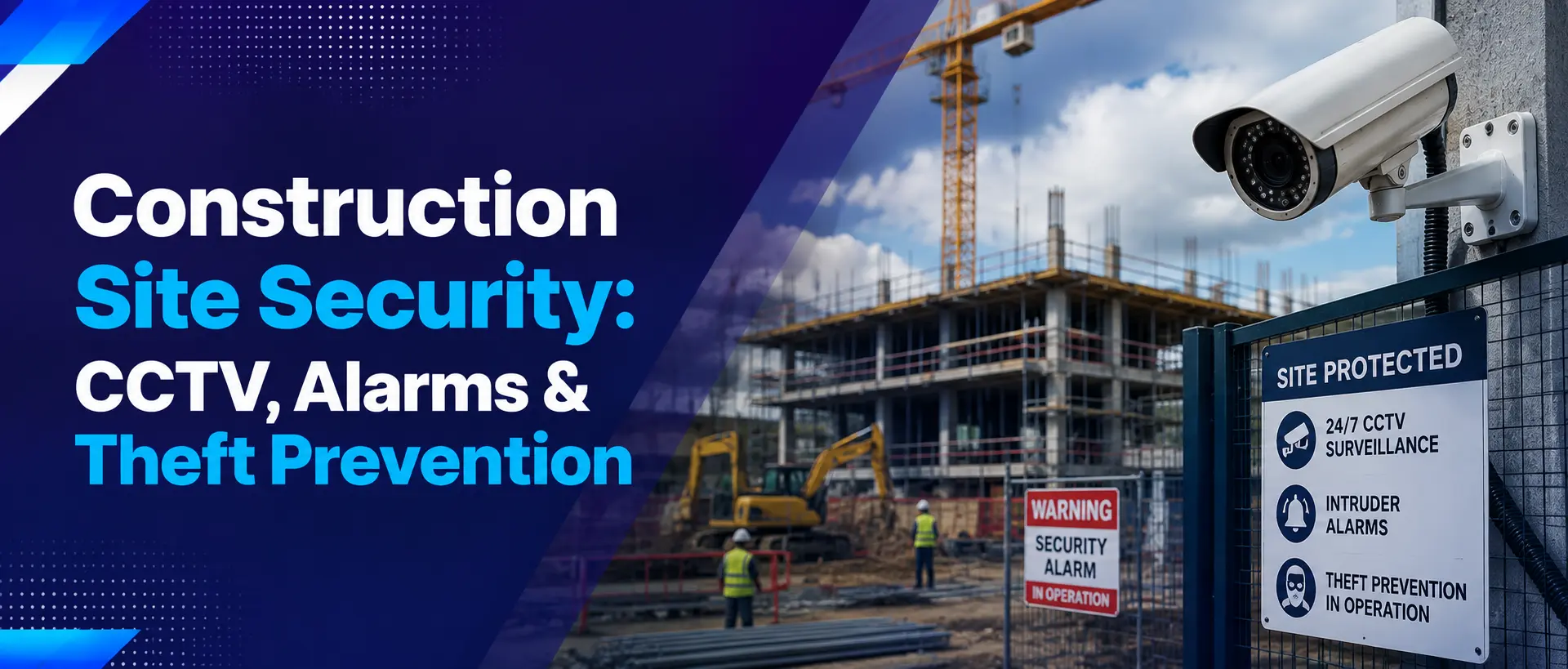
Construction sites can be attractive targets for thieves, vandals and trespassers. Valuable tools, plant, machinery, fuel, materials and equipment may be left on site, while partially completed buildings can provide multiple access points and areas that are difficult to monitor.
Effective construction site security is therefore about more than putting a camera at the entrance. A properly planned security strategy can combine CCTV, intelligent video analytics, intruder alarms, access control, security lighting, perimeter protection and remote monitoring to help deter unwanted activity and improve the response to incidents.
In this guide, we explain the main security risks construction companies face, how modern security systems can help and what businesses should consider when protecting a construction site in the UK.
Why Is Construction Site Security Important?
Construction sites change constantly. Fencing, entrances, temporary buildings, scaffolding, plant areas and storage locations may move as the project progresses.
This creates a different security challenge from a permanent office or commercial building. Security measures need to be flexible enough to adapt as the site develops.
Theft can cause more than the replacement cost of missing equipment. A stolen tool or piece of machinery can delay work, disrupt schedules and create additional costs for contractors and project managers.
Vandalism and unauthorised access can also create safety concerns, property damage and delays to construction work.
A layered security approach can help businesses identify risks earlier and provide better protection throughout the construction project.
Common Security Risks on Construction Sites
Every site has different risks, but several security problems occur repeatedly across construction projects.
1. Theft of Tools and Equipment
Portable tools, power equipment and specialist construction equipment can be valuable and relatively easy to remove from a site.
2. Plant and Machinery Theft
Larger equipment such as excavators, generators and other plant can also be targeted. Vehicle and equipment security should therefore form part of the overall site strategy.
3. Material Theft
Construction materials stored on site can become targets, particularly when they are valuable, easily accessible or left in unsecured areas.
4. Vandalism
Damage to partially completed buildings, equipment, vehicles and temporary facilities can result in repair costs and project delays.
5. Trespassing
Unauthorised people may enter a construction site through damaged fencing, unsecured gates or other access points.
6. Unauthorised Vehicle Access
Construction sites can have multiple vehicle entrances and temporary access routes. Poorly controlled vehicle access can increase both security and safety risks.
7. Overnight Security Gaps
Sites are often quieter outside working hours, which can make evenings, nights, weekends and holidays particularly important periods for security planning.
Construction Site CCTV
CCTV is one of the most useful components of a construction site security system. Cameras can provide visibility across entrances, perimeter areas, storage locations, plant areas and other vulnerable parts of the site.
A properly designed system can also provide recorded evidence when an incident occurs. More importantly, visible CCTV can act as part of a wider deterrence strategy.
Where Should Construction Site Cameras Be Installed?
Camera locations should be determined by the site's risk assessment rather than simply placing cameras wherever installation is easiest.
Common locations include:
- Main vehicle entrances
- Pedestrian entrances
- Perimeter fencing
- Material storage areas
- Plant and machinery areas
- Temporary offices
- Welfare facilities
- Fuel storage areas
- Loading and unloading zones
- Car parks and vehicle areas
Camera positioning should also account for lighting, potential obstructions and changes to the site as construction progresses.
For a more detailed overview of commercial CCTV planning, see our Commercial CCTV Installation Guide .
Temporary and Mobile CCTV for Construction Sites
Construction projects often require security before permanent infrastructure is available. Temporary or mobile CCTV systems can provide a flexible solution for sites that change throughout the project.
Depending on the system, mobile CCTV units may be positioned around the site and relocated as construction progresses.
This can be particularly useful when:
- The site perimeter changes regularly.
- Permanent power or network infrastructure is not yet available.
- Additional monitoring is required for a high-risk area.
- The project is temporary.
- Security requirements change between construction phases.
The right solution will depend on the site's size, power availability, connectivity, location and monitoring requirements.
AI-Powered CCTV for Construction Sites
Modern CCTV systems can include intelligent video analytics that help identify specific types of activity rather than simply detecting general movement.
Depending on the equipment, AI-powered CCTV may provide features such as:
- Human detection
- Vehicle detection
- Intrusion detection
- Line-crossing detection
- Loitering detection
- Restricted-area monitoring
- Smart event alerts
For example, a virtual boundary can be created around a restricted plant area. If a person enters that zone outside permitted hours, the system may generate an alert depending on its configuration.
AI CCTV should not be viewed as a replacement for good site security design. It works best as part of a layered approach involving cameras, alarms, access control and appropriate monitoring.
Read our dedicated guide: AI-Powered CCTV Cameras: Smarter Security for Modern Businesses .
Intruder Alarms for Construction Sites
CCTV provides visual monitoring, but alarms can provide another important layer of protection.
An appropriately designed intruder alarm can help detect unauthorised entry into protected buildings, temporary offices, storage areas and other vulnerable locations.
Depending on the system, alarm protection may include:
- Door contacts
- Window contacts
- Motion detectors
- Perimeter detection
- Control panels
- Audible alarms
- Visual warning devices
- Remote signalling
Construction sites can change quickly, so alarm zones and protected areas may need to be reviewed as different parts of the project become operational.
Regular servicing is also important. For more information, see our Intruder Alarm Maintenance Checklist for UK Businesses .
Perimeter Security for Construction Sites
A strong perimeter is one of the first lines of defence for a construction site.
Security measures should consider fencing, gates, access points, temporary openings and areas where fencing may be vulnerable to damage or climbing.
Security Fencing
Site fencing should be maintained throughout the project rather than only checked when construction begins.
Secure Gates
Gates should be controlled according to the site's access requirements. Where appropriate, access control can help limit entry to authorised personnel.
Perimeter CCTV
Cameras positioned towards vulnerable perimeter areas can provide visibility around the site's boundary.
Security Lighting
Suitable lighting can improve visibility around entrances, walkways and vulnerable areas. Lighting should be designed alongside CCTV rather than treated as a completely separate consideration.
Access Control for Construction Sites
Construction sites can involve employees, subcontractors, delivery drivers, visitors, inspectors and other authorised personnel.
Access control can help businesses manage who is allowed into particular areas and reduce unnecessary access to restricted locations.
Depending on the project, access control can include:
- Keypad entry
- Proximity cards
- Electronic access systems
- Vehicle access control
- Intercom systems
- Video door entry
Access permissions should also be reviewed when workers leave the project or their role changes.
Remote CCTV Monitoring for Construction Sites
One of the challenges of construction site security is that there may be no staff present outside normal working hours.
Remote monitoring can provide an additional layer of oversight by allowing security events to be assessed away from the physical site, depending on the monitoring service and system configuration.
Instead of relying solely on recorded footage discovered after an incident, monitored systems may allow relevant events to be assessed closer to the time they occur.
This can be particularly useful for larger sites, isolated locations and projects where valuable equipment is stored overnight.
Security Lighting
Lighting plays an important supporting role in construction site security.
Well-positioned lighting can improve visibility around entrances, storage areas and other vulnerable locations. It can also help CCTV cameras capture clearer footage in low-light conditions, depending on the camera technology.
Lighting should be designed carefully to avoid creating glare that could reduce CCTV image quality.
How to Protect Plant, Tools and Construction Materials
Security measures should be prioritised according to the value and vulnerability of assets on the site.
Practical measures can include:
- Storing smaller tools in secure areas.
- Restricting access to plant and machinery.
- Using CCTV around high-value storage areas.
- Keeping valuable materials away from vulnerable perimeter points.
- Maintaining secure gates and fencing.
- Using appropriate lighting around storage areas.
- Reviewing security arrangements when the site layout changes.
Security should be reviewed throughout the construction project because the value and location of assets often change as work progresses.
Construction Site Security Outside Working Hours
A site that is busy during the day can become significantly more vulnerable when workers leave.
Before the site closes each day, businesses should ensure that:
- Gates are secured.
- Temporary access points are checked.
- Tools and equipment are secured.
- Alarm systems are armed where appropriate.
- CCTV is operational.
- Security lighting is working.
- Perimeter fencing has no obvious gaps or damage.
- Unauthorised vehicles have been removed.
A clear closing procedure can reduce avoidable security weaknesses.
Construction Site Security Checklist
Use the following checklist as a starting point when reviewing your construction site's security.
| Security Area | What to Check |
|---|---|
| Perimeter | Check fencing, gates and vulnerable boundary points. |
| CCTV | Check camera coverage, image quality, recording and vulnerable areas. |
| AI Analytics | Review human, vehicle, intrusion and line-crossing detection where applicable. |
| Intruder Alarm | Check sensors, alarm zones, control equipment and signalling. |
| Access Control | Review authorised users, access points and permissions. |
| Lighting | Check entrances, storage areas and other vulnerable locations. |
| Plant & Tools | Secure valuable equipment and review storage arrangements. |
| Remote Monitoring | Confirm alerts, connectivity and monitoring arrangements are working. |
| Site Changes | Update security arrangements as the construction layout develops. |
| Maintenance | Schedule regular testing and professional servicing of security systems. |
CCTV and GDPR Considerations for Construction Sites
CCTV used on a construction site may capture employees, contractors, visitors, delivery drivers and members of the public.
Businesses therefore need to consider applicable data protection requirements when deploying CCTV and other surveillance technologies.
The Information Commissioner's Office advises organisations using CCTV to consider matters including the purpose of surveillance, transparency, lawful processing, security and how long recordings are retained.
Businesses should also consider where cameras point and whether they are capturing areas that do not need to be monitored.
Where more advanced technologies are used, such as facial recognition or other systems involving particularly sensitive processing, additional considerations may apply.
Organisations should review the ICO's current guidance and obtain appropriate professional advice where necessary.
How Much Does Construction Site Security Cost?
The cost of construction site security varies significantly depending on the size, location, layout and risk profile of the project.
Factors that can affect the cost include:
- Number and type of CCTV cameras
- Temporary or permanent CCTV requirements
- AI analytics
- Intruder alarm requirements
- Perimeter protection
- Access control
- Security lighting
- Remote monitoring
- Power and network availability
- Site size and complexity
- Maintenance and servicing
A professional site assessment is generally the best way to determine what level of security is appropriate.
Rather than installing the maximum number of cameras or sensors, businesses should focus on protecting the areas where the risk and potential loss are greatest.
Common Construction Site Security Mistakes
Relying on CCTV Alone
CCTV is valuable, but cameras should ideally form part of a layered security system.
Ignoring the Perimeter
A high-quality camera system cannot compensate for unsecured gates, damaged fencing or uncontrolled access points.
Not Updating Security as the Site Changes
Construction sites evolve. Camera locations, access points and storage areas may need to change as the project progresses.
Using Poor Lighting
Poor lighting can reduce visibility and affect CCTV performance.
Forgetting Maintenance
Cameras, alarms and monitoring equipment need regular checks. A security system that fails when it is needed provides little protection.
Failing to Secure Remote Access
Network-connected security equipment should be configured and protected appropriately. Password management, updates and network security should not be overlooked.
When Should You Upgrade Construction Site Security?
A security review should be considered when the site changes significantly or when existing measures are no longer appropriate.
Warning signs can include:
- Repeated theft or attempted theft.
- Damage to perimeter fencing.
- Repeated unauthorised access.
- Blind spots in CCTV coverage.
- Poor night-time footage.
- Frequent false alarms.
- Security equipment that is unreliable or outdated.
- New high-value equipment being stored on site.
- Major changes to the site layout.
- Additional entrances or access routes being introduced.
Choosing a Professional Construction Site Security Installer
Construction site security should be designed around the specific project rather than treated as a standard package.
When selecting a security company, consider:
- Experience with commercial security installations.
- Experience with CCTV and alarm systems.
- Ability to design temporary or changing site solutions.
- Remote monitoring capabilities where required.
- Maintenance and support services.
- System integration experience.
- Clear documentation and system handover.
A good installer should begin by understanding the site, its risks and the project's requirements before recommending equipment.
Why a Layered Security Approach Works Best
No single security measure can eliminate every risk on a construction site.
CCTV can provide visibility. Intruder alarms can detect unauthorised entry. Access control can help manage authorised users. Perimeter protection can make unauthorised access more difficult, while remote monitoring can provide an additional layer of response.
Combining these technologies creates multiple layers of protection.
A typical construction site security solution could include:
- Perimeter fencing and secure gates
- Commercial CCTV
- AI-powered video analytics
- Intruder alarms
- Access control
- Security lighting
- Remote monitoring
- Regular maintenance
Protect Your Construction Site with Professional Security
Construction sites face changing risks throughout every stage of a project. From the early groundwork phase through to completion, security requirements can change as equipment, materials, buildings and access routes are introduced.
Third Eye Security can help businesses assess their CCTV, alarm and wider security requirements and develop a solution designed around the individual site.
Whether you need construction site CCTV, intelligent video analytics, intruder alarms, access control or a combination of security measures, professional planning can help protect your investment.
Contact Third Eye Security to discuss your construction site security requirements.
Conclusion
Construction site security requires more than simply installing a CCTV camera at the entrance. Sites contain valuable equipment and materials, change throughout the project and can have multiple vulnerable access points.
A layered security strategy can combine CCTV, AI-powered video analytics, intruder alarms, access control, perimeter protection, security lighting and remote monitoring to create a stronger overall security system.
The most effective solution is one that is designed around the specific site. Security requirements should be reviewed as construction progresses and equipment, access routes and vulnerable areas change.
For UK construction companies, CCTV and surveillance should also be planned with privacy and data protection responsibilities in mind.
By combining appropriate technology with professional installation, regular maintenance and sensible site procedures, construction businesses can improve visibility, reduce vulnerabilities and better protect valuable assets.
If you are planning security for a construction project, speak to Third Eye Security about a solution designed around your site.