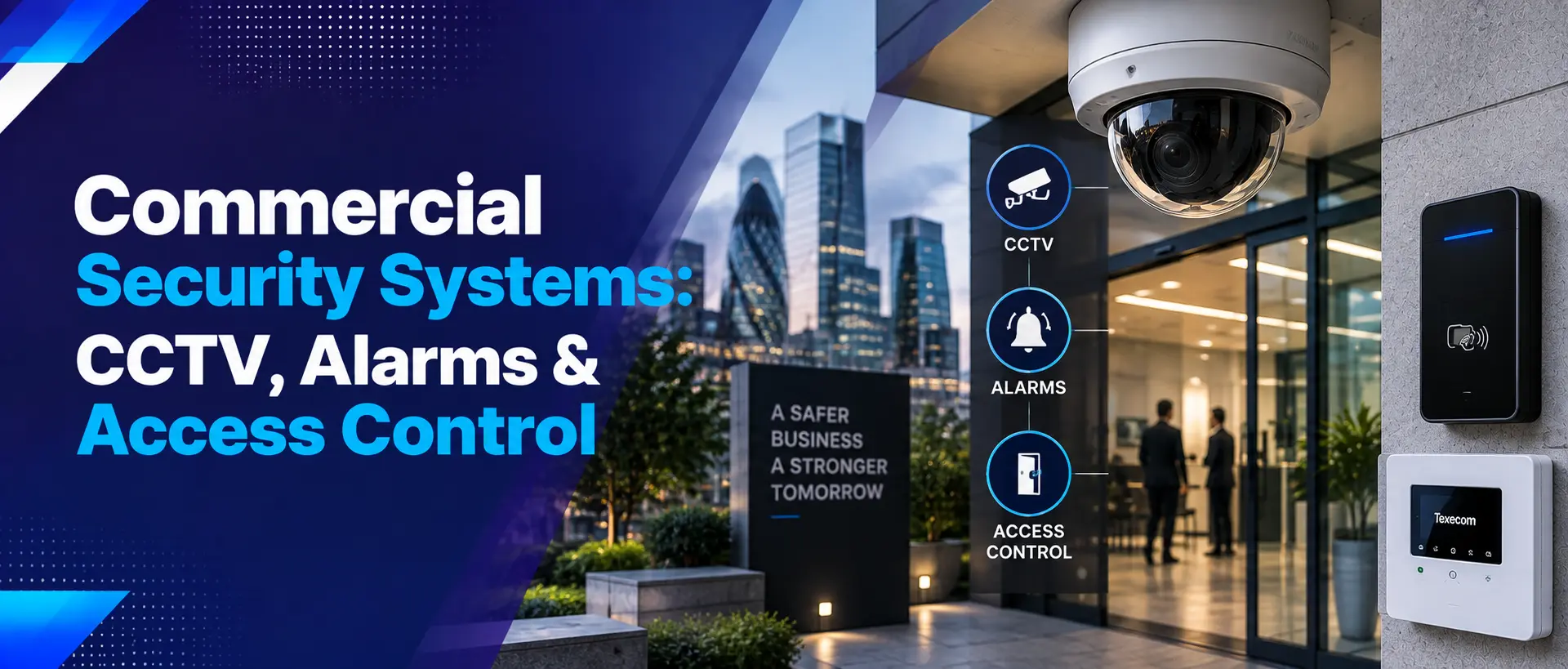
Modern businesses face a wide range of security risks, from theft and vandalism to unauthorised access, internal security concerns and out-of-hours incidents. A well-designed commercial security system brings different technologies together to help protect your premises, people, equipment, stock and information.
CCTV cameras, intruder alarms and access control systems each perform a different role. When properly designed and integrated, they can provide a stronger and more coordinated approach to business security than relying on one security measure alone.
What Are Commercial Security Systems?
Commercial security systems are security technologies designed to protect business premises and the people and assets within them. Depending on the property and its risks, a system may include CCTV, intruder alarms, access control, video door entry, security lighting, perimeter protection and remote monitoring.
The most effective systems are not simply a collection of cameras and alarms. They are planned around the individual risks of the business, including the building layout, access points, operating hours, staff numbers, valuable assets and potential security threats.
For example, an office may require controlled access to reception, server rooms and staff areas, while a warehouse may need perimeter CCTV, vehicle monitoring, access control and protection for loading bays.
Why Do Businesses Need Integrated Security?
Using a single security technology can leave gaps. CCTV can show what happened, but it may not prevent an intruder from entering. An alarm can detect an intrusion, but it may not show exactly where the incident occurred or who was involved.
Integration allows different systems to support each other.
| Security System | Main Purpose | Typical Business Benefit |
|---|---|---|
| CCTV | Visual monitoring and recording | Evidence, deterrence and incident verification |
| Intruder Alarm | Detect unauthorised entry | Rapid detection of break-ins |
| Access Control | Manage who can enter areas | Restricted access and improved accountability |
| Video Door Entry | Verify visitors before access | Improved visitor management |
| Security Lighting | Improve visibility and deterrence | Reduced opportunities for criminal activity |
| Remote Monitoring | Monitor systems away from site | Faster awareness of incidents |
An integrated approach means an incident detected by one system can trigger or support another. For example, an alarm activation can help direct attention to a specific CCTV camera, allowing an authorised person or monitoring team to assess what is happening.
Commercial CCTV Systems
CCTV is one of the most widely used components of a business security system. Modern commercial CCTV systems can provide high-definition video, night vision, remote viewing, motion detection, intelligent analytics and secure recording.
The objective should not simply be to install as many cameras as possible. Camera positions, viewing angles, lighting conditions, image quality and recording requirements all need to be considered during the design.
Common commercial CCTV camera locations
- Building entrances and exits
- Reception areas
- Car parks and vehicle entrances
- Loading bays
- Warehouses and storage areas
- Cash handling areas
- Stockrooms
- Perimeter boundaries
- Plant and equipment areas
- Other higher-risk areas identified during a security assessment
If you are planning a new system, our Commercial CCTV Installation Guide explains the main considerations involved in designing CCTV for business premises.
AI-Powered CCTV for Businesses
CCTV technology has moved beyond simple recording. Many modern systems now use intelligent video analytics to help identify specific events and reduce unnecessary alerts.
Depending on the system, analytics may help identify people or vehicles, line crossing, intrusion into defined areas, loitering or other pre-configured events.
AI should be treated as a tool that supports security teams rather than a replacement for sensible security planning and human decision-making.
Read our detailed guide to AI-Powered CCTV Cameras for Modern Businesses to learn more about intelligent video surveillance.
Commercial Intruder Alarm Systems
Intruder alarms are designed to detect unauthorised entry or activity within protected areas. They can provide an important additional layer of protection when a business is closed or when restricted areas need additional security.
Typical commercial alarm components include:
- Control panels
- Door and window contacts
- Motion detectors
- Glass-break detection where appropriate
- Internal and external sounders
- Keypads or other user interfaces
- Backup batteries
- Communication devices
- Different alarm zones
Alarm systems can be configured around the way a business operates. For example, different areas may be armed at different times, allowing authorised staff to work in one part of a building while other areas remain protected.
Regular servicing is essential because sensors, batteries, communication equipment and other components need to remain operational.
For practical maintenance advice, see our Intruder Alarm Maintenance Checklist for UK Businesses .
Access Control Systems
CCTV helps businesses see what is happening, while access control helps determine who is allowed to enter specific areas.
Access control can be particularly useful for offices, warehouses, industrial buildings, commercial sites and premises where different employees require access to different areas.
Common access control methods include:
- Proximity cards
- Key fobs
- PIN codes
- Mobile credentials
- Biometric systems where appropriate
- Electronic door locks
- Intercom-controlled access
- Multi-door access control systems
Access permissions can often be assigned according to employee role, department or working hours. This can reduce the need for physical keys and make it easier to manage access when employees join or leave the organisation.
Access control can also provide useful audit information, depending on the system and configuration.
Video Door Entry Systems
Video door entry combines communication and visual verification at an entrance. A visitor can request access while an authorised person checks who is at the door before allowing entry.
This can be useful for offices, apartment buildings, reception areas, commercial premises and sites where controlled visitor access is important.
A modern video door entry system may include a camera, microphone, speaker, internal monitor and electronic door release.
For businesses considering this option, video door entry can complement both access control and CCTV rather than replacing either system.
Security Lighting
Lighting is often overlooked when businesses plan security. However, poor visibility can reduce the effectiveness of CCTV and create opportunities around entrances, car parks and perimeter areas.
Security lighting can be used around:
- Entrances and exits
- Car parks
- Loading bays
- Building perimeters
- Storage areas
- Plant and equipment areas
Lighting should be planned alongside CCTV rather than treated as a completely separate consideration. The correct lighting can help cameras capture more useful footage, particularly during hours of darkness.
Remote CCTV Monitoring
Remote access allows authorised users to view security systems away from the premises. Depending on the system, this may include live CCTV viewing, event notifications, alarm information and remote system management.
Remote monitoring can be particularly useful for businesses that operate across multiple locations or have premises that remain unattended overnight.
However, remote access also needs to be secured properly. Businesses should use strong authentication, appropriate permissions, secure network configurations and controlled user access.
Internet-connected CCTV can involve the processing of personal data, so businesses should consider both cybersecurity and data protection when selecting and configuring systems. The ICO specifically highlights security and access controls for video surveillance systems. :contentReference[oaicite:1]{index=1}
Perimeter Security
For larger sites, warehouses, industrial premises and construction sites, security needs to begin before someone reaches the main building.
Perimeter security can include:
- Perimeter CCTV
- Security lighting
- Gates and barriers
- Vehicle access control
- Intruder detection
- Fencing and physical barriers
- Controlled pedestrian entrances
Combining physical security with electronic detection can help businesses identify suspicious activity earlier and reduce opportunities for unauthorised access.
How Commercial Security Systems Work Together
The real value of an integrated security system comes from how the different components support one another.
Example scenario
Imagine a warehouse that closes at 7pm. After closing, the access control system restricts entry, the intruder alarm protects internal areas and CCTV continues recording the site.
If an alarm event occurs, the business or monitoring team can use CCTV to assess the relevant area. If the event involves an entrance, access control records may provide additional context about authorised access.
This creates a more complete security picture than any single system could provide on its own.
Commercial Security Systems for Offices
Offices often require a combination of CCTV, access control and visitor management.
Typical office security requirements include:
- Reception and entrance CCTV
- Controlled staff access
- Visitor management
- Server room access control
- Intruder alarm protection
- Car park monitoring
- Out-of-hours protection
Security systems should be designed carefully around employee privacy and legitimate business requirements.
You can also review our Office Security Checklist for additional ways to improve workplace security.
Commercial Security Systems for Warehouses
Warehouses can have large perimeters, multiple access points, loading bays, valuable stock and areas that remain unattended for long periods.
A warehouse security system may therefore combine:
- High-definition internal and external CCTV
- AI video analytics
- Perimeter monitoring
- Intruder alarms
- Vehicle access control
- Staff access control
- Loading bay monitoring
- Remote viewing
Read our Warehouse Security Best Practices for a more detailed approach to protecting warehouse premises and stock.
Commercial Security Systems for Retail Stores
Retail security has to balance customer experience, staff safety, stock protection and loss prevention.
CCTV can help monitor entrances, sales areas, tills and stockrooms, while alarms can protect the premises outside trading hours.
Access control can also be useful for staff-only areas such as stockrooms, offices and secure storage.
AI-powered CCTV may provide additional event detection where appropriate.
For a more detailed retail-focused approach, read our Retail Security Guide .
Commercial Security Systems for Construction Sites
Construction sites can face theft of tools, plant, fuel, materials and equipment, particularly outside normal working hours.
Temporary or mobile CCTV, remote monitoring, intruder detection, perimeter protection and security lighting can be combined to provide protection while the site is active and when it is unattended.
Security systems should also be adaptable because construction sites change as the project progresses.
See our Construction Site Security Guide for more information.
Security for Industrial & Commercial Premises
Industrial sites often have more complex security requirements than smaller commercial premises.
There may be multiple buildings, vehicle entrances, staff areas, restricted zones, external storage, machinery and valuable materials.
An integrated system can combine CCTV, access control, alarms and perimeter protection to create different levels of security across the site.
For larger sites, security design should begin with a detailed assessment of the premises and the potential threats rather than starting with a particular camera or alarm product.
Wired vs Wireless Commercial Security Systems
Both wired and wireless technologies can be suitable for commercial security. The right choice depends on the building, infrastructure, reliability requirements, installation conditions and future expansion plans.
| Feature | Wired Systems | Wireless Systems |
|---|---|---|
| Installation | Requires cabling | Can reduce cabling requirements |
| Large Sites | Often suitable for permanent installations | Useful where cabling is difficult |
| Expansion | May require additional cabling | Can be easier in some environments |
| Reliability | Can provide consistent physical connectivity | Depends on wireless infrastructure and system design |
| Best Choice | Often suited to new-build or permanent systems | Can be useful for selected retrofit or flexible applications |
There is no universal winner. A professional security survey should determine which approach is appropriate for the individual premises.
CCTV, GDPR & Privacy Considerations for UK Businesses
Businesses using CCTV or other video surveillance should consider data protection requirements where identifiable individuals are captured.
The ICO states that organisations using surveillance systems that process personal data relating to identifiable individuals need to consider their obligations under the UK GDPR and Data Protection Act 2018. :contentReference[oaicite:2]{index=2}
Businesses should consider:
- Why the surveillance system is necessary
- What areas need to be monitored
- Whether the surveillance is proportionate
- How people will be informed
- Appropriate signage
- How footage will be stored and protected
- Who can access recordings
- How long footage should be retained
- How footage can be retrieved when required
- Whether additional privacy assessments are necessary
CCTV should not automatically be installed in every possible location. Camera positioning should be based on a legitimate security purpose while considering people's privacy.
The ICO also advises organisations to document their reasons for using CCTV and consider a Data Protection Impact Assessment where the processing is likely to result in a high risk to individuals. :contentReference[oaicite:3]{index=3}
This article provides general information rather than legal advice. Businesses should check current ICO guidance and obtain professional advice where appropriate.
Protecting CCTV Systems from Cyber Risks
Modern CCTV systems are increasingly connected to networks, apps and remote services. That provides useful flexibility, but it also means cybersecurity needs to be part of the system design.
Good security practices include:
- Use strong and unique passwords
- Restrict administrator access
- Keep supported systems and firmware updated
- Use secure network configurations
- Control remote access permissions
- Protect recording equipment physically
- Use appropriate encryption and authentication
- Remove access for former employees or contractors
Businesses should treat the CCTV recorder, network equipment and user accounts as part of the overall security environment rather than focusing only on the cameras.
Commercial Security System Maintenance
Even the best security system can become unreliable if it is not maintained.
Routine checks can identify problems before an incident occurs.
CCTV maintenance should include:
- Checking camera image quality
- Cleaning lenses where necessary
- Checking night vision
- Checking recording functionality
- Testing storage capacity
- Checking remote access
- Reviewing camera positioning
- Checking network connections
Alarm maintenance should include:
- Testing sensors
- Checking batteries
- Testing alarm zones
- Checking communication equipment
- Testing sounders
- Reviewing false alarm history
Access control maintenance should include:
- Testing readers
- Checking electronic locks
- Reviewing user permissions
- Removing inactive users
- Testing emergency release functions
- Checking access records where applicable
A regular maintenance programme can help keep the system effective as the business, building and security requirements change.
How Much Do Commercial Security Systems Cost?
There is no single price for a commercial security system because every business has different requirements.
The total cost can depend on:
- Number and type of CCTV cameras
- Camera resolution and analytics
- Number of doors requiring access control
- Alarm system size
- Building layout
- Cabling requirements
- Network infrastructure
- Storage requirements
- Remote monitoring requirements
- Perimeter security
- Installation complexity
- Maintenance and ongoing support
Businesses should avoid choosing a security system based purely on the lowest installation price. A cheaper system may not provide the coverage, reliability, storage, scalability or support the business actually needs.
A better approach is to establish the security risks first and then compare systems based on coverage, functionality, reliability and long-term value.
How to Choose a Commercial Security Company
Selecting the right installer is just as important as selecting the equipment.
Before appointing a security company, businesses should consider:
- Experience with commercial properties
- Understanding of the site's security risks
- Quality and suitability of proposed equipment
- Installation standards
- System integration capabilities
- Maintenance and servicing options
- Remote support
- Future expansion options
- Clear quotations and specifications
- After-sales support
A professional installer should be able to explain why particular cameras, alarm devices, access control components and other technologies are being recommended.
Common Commercial Security Mistakes
1. Installing cameras without a proper survey
Poor camera positioning can result in blind spots, poor identification and unnecessary coverage.
2. Focusing only on CCTV
CCTV is valuable, but it is only one layer of a complete security strategy.
3. Ignoring access control
If anyone can freely enter sensitive areas, cameras alone may not provide enough protection.
4. Forgetting about out-of-hours security
Many businesses are more vulnerable when staff have left. Alarm systems, remote monitoring, lighting and secure access can help address this period.
5. Not maintaining the system
Dirty cameras, failed batteries, inactive users and faulty sensors can reduce the effectiveness of a security system.
6. Keeping the same security plan forever
Businesses change. Extensions, new entrances, additional staff, new stock and changes in working hours can all create new security requirements.
Complete Commercial Security Checklist
| Security Area | What to Check |
|---|---|
| CCTV | Coverage, image quality, recording and blind spots |
| AI Analytics | Relevant detection rules and useful alert configuration |
| Intruder Alarm | Sensors, zones, batteries and communication |
| Access Control | Doors, users, permissions and audit records |
| Entry Points | Main entrances, staff entrances and loading areas |
| Perimeter | Fencing, gates, external cameras and lighting |
| Remote Access | Secure login, user permissions and connectivity |
| Data Protection | Purpose, signage, retention, access and privacy |
| Maintenance | Regular testing, servicing and fault detection |
| Future Expansion | Whether the system can adapt as the business grows |
A more detailed starting point is our Business Security Risk Assessment Checklist , which can help identify vulnerabilities before deciding which technology is required.
When Should a Business Upgrade Its Security System?
An upgrade may be worth considering if your current system is becoming difficult to manage, no longer provides adequate coverage or does not support the way your business now operates.
Common warning signs include:
- Frequent CCTV failures
- Poor image quality
- Blind spots around important areas
- Outdated recording equipment
- Limited remote access
- Frequent false alarms
- Lost or uncontrolled physical keys
- Former employees retaining access
- New entrances or building extensions
- Changes in stock, equipment or business operations
- No regular security maintenance
An upgrade does not always mean replacing everything. In many cases, an existing system can be improved by replacing specific components or integrating additional technologies.
Why a Security Risk Assessment Should Come First
The best commercial security system starts with the question: what are you trying to protect, and what are the realistic threats?
A security risk assessment can identify:
- Vulnerable entrances
- Areas with poor visibility
- High-value assets
- Potential internal security risks
- Perimeter weaknesses
- Out-of-hours vulnerabilities
- Access control gaps
- Existing system weaknesses
This helps prevent businesses from spending money on technology that does not address their most important risks.
Why Choose Third Eye Security?
Every business premises is different, which is why commercial security should be designed around the property rather than based on a one-size-fits-all package.
Third Eye Security can help businesses assess their requirements and develop security solutions that combine CCTV, intruder alarms, access control and other technologies where appropriate.
Whether you are securing an office, warehouse, retail unit, industrial premises or construction site, the objective is to create a practical system that provides the right level of protection today while allowing room for future changes.
Need a Commercial Security System?
Protect your premises, people and assets with a professionally designed commercial security solution. From CCTV and AI-powered surveillance to intruder alarms and access control, Third Eye Security can help you identify the right combination for your business.
Contact Third Eye SecurityBuild a Security System Around Your Business
Commercial security works best when different layers work together. CCTV provides visibility, intruder alarms help detect unauthorised activity, and access control helps manage who can enter restricted areas.
By combining these technologies with appropriate lighting, perimeter protection, maintenance and sensible security procedures, businesses can create a more resilient security environment.
The starting point should always be understanding the risks. Once those risks are clear, the right technology can be selected to provide practical, scalable and effective protection.
Need help planning commercial security for your premises? Contact Third Eye Security to discuss your requirements.