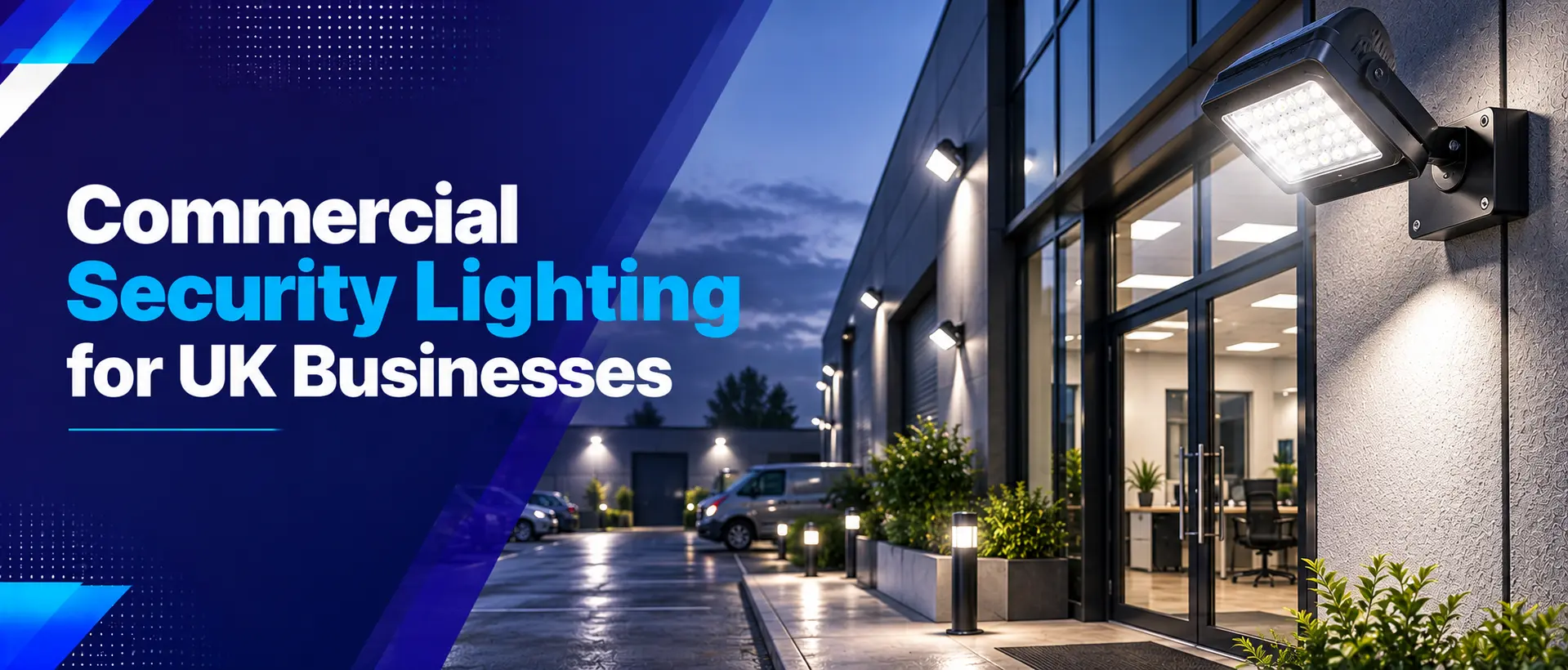
A business premises can look completely different after dark. Entrances become harder to see, car parks develop dark corners, and delivery areas may be left with limited visibility once normal working hours end. These conditions can make it more difficult for staff, visitors and security teams to identify activity around the property.
Commercial security lighting helps improve visibility around business premises by illuminating important areas such as entrances, walkways, loading bays, boundaries and parking facilities. When planned alongside CCTV, intruder alarms and access control, lighting can form part of a coordinated security system.
This guide explains the main types of commercial security lighting, where to install them, how they can support CCTV, and what businesses should consider when choosing a lighting system.
What Is Commercial Security Lighting?
Commercial security lighting is lighting installed to improve visibility and support the security of business properties. It may operate continuously during specified hours, switch on when movement is detected, or respond to a combination of sensors and control settings.
Unlike decorative or general-purpose lighting, security lighting is planned around practical needs: illuminating access points, reducing poorly lit areas, helping people move safely around the site, and providing usable images for CCTV cameras.
Common applications include:
- Office entrances, exits and external walkways
- Warehouse yards and loading bays
- Commercial car parks and vehicle entrances
- Retail premises and service areas
- Construction sites and temporary compounds
- Perimeter fences, gates and access roads
- External plant rooms and equipment areas
Why Is Security Lighting Important for Businesses?
1. Improves visibility around the premises
Adequate lighting makes it easier for employees, visitors and security personnel to see entrances, pathways, obstacles and activity around a property. It can also help staff identify unfamiliar people or vehicles when arriving early or leaving late.
2. Supports CCTV performance
CCTV cameras need suitable lighting to capture useful footage. Poor lighting can result in dark images, limited detail or glare from nearby light sources. Carefully positioned lighting can help cameras capture clearer images of relevant areas.
Lighting should be planned with camera position, lens direction, distance and night-time performance in mind. For more guidance, read our commercial CCTV installation guide and guide to AI-powered CCTV cameras.
3. Helps staff and visitors move safely
Well-lit walkways, stairs, entrances and parking areas can make it easier for people to navigate the site after dark. Lighting should be considered as part of a wider site-safety approach, rather than only as a security measure.
4. Makes activity easier to monitor
Lighting can improve visibility for on-site staff and security teams carrying out checks. It can also make it easier to review CCTV footage when an incident or unusual event needs to be investigated.
5. Complements other security measures
Security lighting is not a replacement for alarms, CCTV, secure doors or access control. It is one layer within a wider system. Businesses can review their overall arrangements through a business security risk assessment.
Types of Commercial Security Lighting
LED Security Lighting
LED lighting is commonly used in commercial environments because it is available in a range of brightness levels, colour temperatures, beam angles and fixture styles. Suitable LED fittings can be used for entrances, yards, car parks and building perimeters.
When selecting LED fixtures, consider the required coverage, mounting height, weather protection, operating hours and maintenance access. The most powerful fitting is not automatically the most suitable: excessive brightness can create glare and unwanted light spill.
Motion-Activated Security Lights
Motion-activated lights switch on when a sensor detects movement within its configured area. They can be useful for locations that do not need full illumination throughout the night, such as side entrances, service paths and selected perimeter zones.
Sensor settings should be adjusted to suit the site. Poorly positioned sensors may respond to passing traffic, moving vegetation or other activity outside the intended detection area.
Dusk-to-Dawn Lighting
Dusk-to-dawn lighting uses a light sensor to switch fixtures on as natural light decreases and off again when daylight returns. It can provide consistent illumination around areas that require lighting throughout the night.
This approach may suit building entrances, signage, pedestrian routes and selected external areas. A lighting control system can also allow operating hours or zones to be adjusted to the business's needs.
Floodlights
Floodlights are designed to illuminate larger areas, making them useful for yards, loading bays, open parking areas and external storage zones. Their beam angle and mounting position should be selected to cover the intended area without creating excessive glare or shining into neighbouring properties.
Perimeter Security Lighting
Perimeter lighting is used around boundaries, gates, fences and access roads. It can help make activity around the edge of a site more visible to staff and CCTV cameras.
Perimeter lighting should be planned alongside fencing, gates, camera coverage and the layout of the property. For sites with multiple security requirements, see our overview of commercial security systems.
Where Should Businesses Install Security Lighting?
The right locations depend on the building layout, operating hours, access routes and security risks. A site survey can help identify areas where lighting is insufficient or where existing fixtures create glare or shadows.
| Location | Lighting considerations | Security purpose |
|---|---|---|
| Main entrances | Illuminate doors, access readers, steps and nearby approach routes. | Improves visibility for staff, visitors and cameras. |
| Car parks | Consider pedestrian routes, vehicle spaces, corners and payment areas. | Supports visibility when people arrive or leave after dark. |
| Loading bays | Provide suitable coverage around doors, vehicle positions and goods-handling areas. | Helps staff monitor deliveries and movement around the bay. |
| Perimeter boundaries | Review gates, fence lines, access roads and camera sightlines. | Improves visibility around boundary areas. |
| Side and rear access | Check service doors, narrow paths and areas screened from street lighting. | Reduces poorly illuminated access points. |
| External storage | Consider the height and arrangement of stored goods, equipment and vehicles. | Supports monitoring of outdoor assets and work areas. |
Commercial Security Lighting for Different Business Types
Offices
Offices may need lighting around reception entrances, staff entrances, external walkways, cycle storage and car parks. If employees work outside standard hours, lighting controls should reflect their arrival and departure patterns.
Businesses can also review lighting alongside their wider office security checklist.
Warehouses and Distribution Centres
Warehouses often have large external areas, vehicle routes, loading bays and goods storage zones. Lighting should support both security monitoring and safe movement around operational areas.
Consider how parked vehicles, stacked materials and building structures affect light coverage and CCTV views. Our article on warehouse security best practices covers additional measures businesses can review.
Retail Premises
Retail security lighting may be needed around shopfronts, rear service doors, delivery areas, external storage and customer parking. The lighting plan should support visibility without causing glare through windows or disturbing nearby properties.
For related measures, see our retail security guide.
Construction Sites
Construction sites can change frequently as equipment, materials, temporary buildings and access routes move. Lighting arrangements should be reviewed as the site develops, particularly around gates, storage areas, temporary walkways and vehicle routes.
Read more in our guide to construction site security.
Integrating Security Lighting with CCTV
Lighting and CCTV should be planned together rather than installed as unrelated systems. A light may illuminate an area for people while still creating glare or an unsuitable image for a camera.
When coordinating lighting and CCTV, consider the following:
- Camera field of view: Check which areas the camera is intended to capture and whether lighting reaches those areas.
- Glare: Avoid positioning lights where they shine directly into the camera lens.
- Shadows: Look for deep shadows created by walls, vehicles, canopies or stored materials.
- Lighting consistency: Large differences between bright and dark areas can affect image detail.
- Night-time testing: Review actual camera footage after dark, not only the daytime view.
- Control settings: Confirm that motion-activated lights operate in a way that supports the camera's recording and monitoring requirements.
Some CCTV systems include infrared or other low-light features. These can be useful in suitable conditions, but the camera's capabilities, scene layout and lighting requirements should still be assessed together.
Common Security Lighting Mistakes to Avoid
Installing lights without a site assessment
A fixture may appear bright during installation but leave important areas in shadow. Review the full site, including access routes, boundaries and areas hidden by structures.
Using excessive brightness
More light does not always mean better visibility. Excessive brightness can create glare, reduce visual comfort and affect CCTV images. Choose fixtures and beam angles based on the area being illuminated.
Ignoring neighbouring properties
External lighting should be directed towards the intended area. Consider light spill onto nearby homes, roads and other premises, and adjust positioning or shielding where necessary.
Not checking sensor coverage
Motion sensors need suitable positioning and settings. Test them in normal operating conditions and adjust sensitivity, detection range and timer settings to reduce unwanted activation.
Forgetting maintenance
Dirt, damaged fittings, failed lamps and changes to the site can affect lighting performance. Include external lights in routine inspections and check that they still cover the intended areas.
Energy Use and Maintenance Considerations
Lighting may operate for long periods, particularly at sites that require overnight illumination. Businesses can review operating hours, zoning and control methods to avoid lighting areas unnecessarily.
Practical considerations include:
- Using suitable LED fixtures where appropriate
- Applying timers, photocells or motion sensors where they fit the site requirements
- Separating lighting into zones so unused areas can be controlled independently
- Choosing durable fittings suitable for their installation environment
- Keeping access available for inspection and maintenance
- Reviewing lighting after building works or changes to site layout
The appropriate controls depend on the site's operating pattern. For example, a warehouse yard with overnight vehicle movements may require a different arrangement from an office entrance used occasionally after hours.
How to Choose a Commercial Security Lighting Installer
Before appointing an installer, businesses should understand what the proposed system is intended to achieve and how its performance will be checked.
Questions to discuss include:
- Will the installer assess the site after dark as well as during daylight?
- Will the lighting plan account for CCTV camera positions and image quality?
- Are the proposed fixtures suitable for the installation environment?
- How will glare, shadows and light spill be addressed?
- Can lighting be divided into separate control zones?
- What inspection and maintenance arrangements are recommended?
- Will the installer explain the controls and provide handover information?
A coordinated assessment can also identify whether lighting should be reviewed alongside CCTV, alarms or access control. Third Eye Security provides commercial security solutions for businesses looking to assess and improve their premises.
Improve Visibility Around Your Business Premises
Commercial security lighting can support safer movement, improve visibility around access points and help CCTV capture useful footage. Its effectiveness depends on choosing suitable fixtures, positioning them carefully and reviewing how they work with the rest of the site's security arrangements.
If your business is reviewing its external lighting, CCTV coverage or wider security system, speak with Third Eye Security about your requirements.
Contact Third Eye Security to discuss your commercial security requirements.