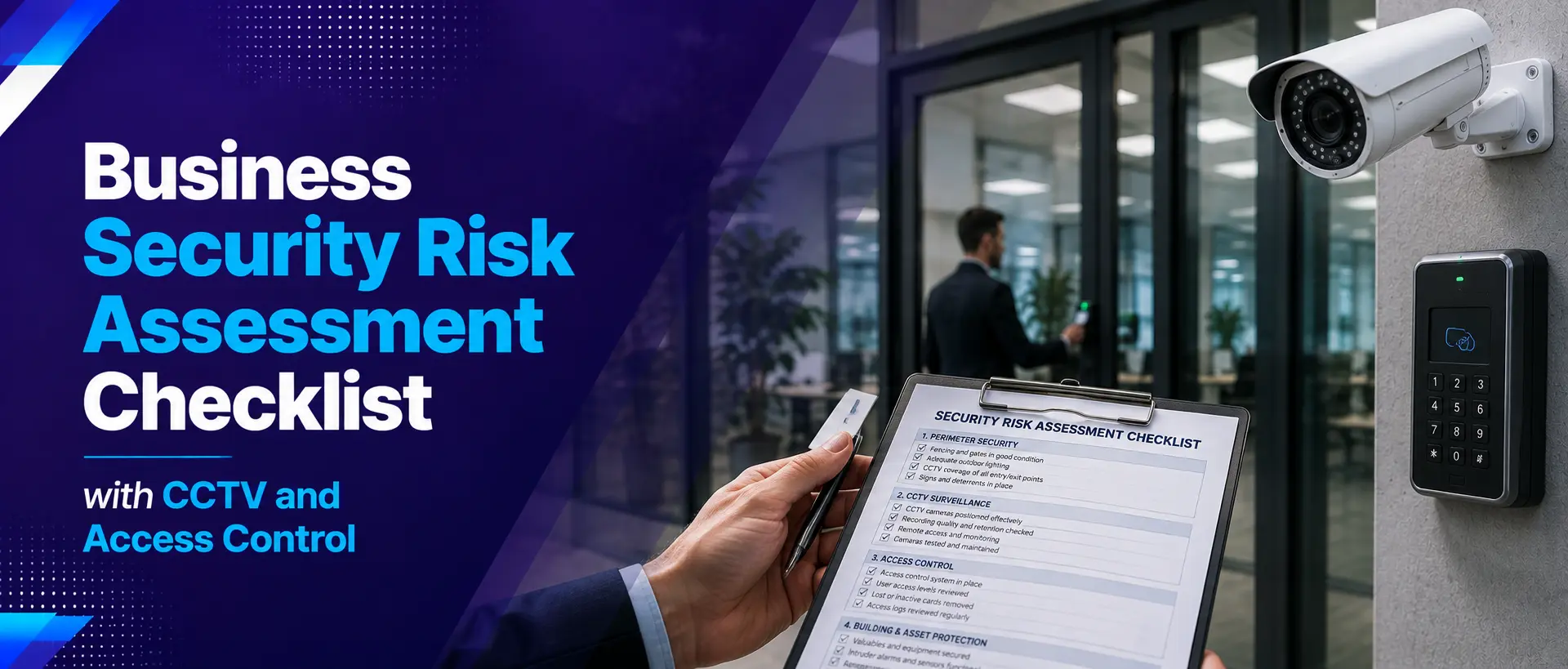
Every business faces different security risks. An office may need to protect employees, confidential information and equipment, while a warehouse may be more concerned with stock theft, unauthorised access and perimeter security. Retail stores, construction sites, industrial premises and other commercial properties all have their own vulnerabilities.
A business security risk assessment helps identify these vulnerabilities before they become serious security incidents. By systematically reviewing your premises, people, equipment, access points and security systems, you can determine where protection needs to be improved.
Security risk assessments should not simply focus on CCTV. A complete assessment can include CCTV, intruder alarms, access control, doors and windows, perimeter protection, lighting, staff procedures, visitor management and other physical security measures.
This checklist explains how UK businesses can review their security arrangements and identify areas that may require improvement, maintenance or an upgrade.
What Is a Business Security Risk Assessment?
A business security risk assessment is a structured review of the threats and vulnerabilities that could affect a company's premises, people, assets and operations.
The objective is to identify potential risks, assess how serious they could be and determine what reasonable security measures can reduce those risks.
A security assessment should consider both the physical property and the way people interact with the building.
A Business Security Assessment Can Review:
- Building entrances and exits.
- Doors and windows.
- CCTV coverage.
- Intruder alarm protection.
- Access control.
- Perimeter security.
- Security lighting.
- Visitor management.
- Employee access.
- Stock and equipment protection.
- Emergency procedures.
- Remote and connected security systems.
Why Do Businesses Need a Security Risk Assessment?
Security risks can change over time. A business may expand into new areas, introduce valuable equipment, change its operating hours or employ more people.
A security system that was suitable several years ago may no longer provide adequate protection. Regular assessments can help businesses identify these changes.
A Security Risk Assessment Can Help You:
- Identify vulnerable areas.
- Prioritise security improvements.
- Review existing CCTV coverage.
- Identify weaknesses in access control.
- Check alarm protection.
- Improve protection of valuable assets.
- Reduce opportunities for unauthorised access.
- Improve staff and visitor security.
- Plan future security upgrades.
How to Conduct a Business Security Risk Assessment
A useful security assessment should be systematic rather than based on a quick visual inspection. Start by understanding the property, its people, its assets and the potential threats.
Step 1: Identify Important Assets
Start by identifying what needs protection. Assets can include people, stock, machinery, vehicles, documents, computers, cash, confidential information and the building itself.
Step 2: Identify Potential Threats
Consider the types of incidents that could affect the business. These may include theft, burglary, vandalism, trespassing, unauthorised access, aggressive behaviour or internal security incidents.
Step 3: Identify Vulnerabilities
Look for weaknesses that could make an incident more likely. Examples include poorly secured doors, blind spots in CCTV coverage, damaged fencing or unrestricted access to sensitive areas.
Step 4: Review Existing Controls
Assess whether existing security measures are working as intended. This should include cameras, alarms, access control, lighting and physical security.
Step 5: Prioritise Risks
Not every vulnerability has the same level of importance. Prioritise risks based on their likelihood, potential impact and the value or sensitivity of what could be affected.
Step 6: Create an Improvement Plan
Document recommended improvements and establish priorities for maintenance, repairs, upgrades or additional security measures.
Physical Security Assessment
Physical security is the foundation of any commercial security strategy. Before reviewing technology, inspect the physical condition of the premises.
Physical Security Checklist
- Are external doors secure?
- Are locks in good condition?
- Are windows appropriately secured?
- Are emergency exits protected against unauthorised access?
- Are gates secure?
- Is perimeter fencing in good condition?
- Are vulnerable areas adequately illuminated?
- Are external storage areas secure?
- Are keys properly controlled?
- Are restricted areas clearly identified?
Physical weaknesses should be addressed even when sophisticated electronic security systems are installed. Technology should complement good physical security rather than replace it.
CCTV Security Assessment
CCTV is an important part of many commercial security systems. However, simply having cameras does not guarantee effective coverage.
A CCTV assessment should determine whether cameras provide useful visibility of the areas that matter most.
CCTV Checklist
- Are all important entrances covered?
- Are exits monitored?
- Are vulnerable external areas covered?
- Are stockrooms protected?
- Are loading areas monitored?
- Are high-value assets visible?
- Are there significant blind spots?
- Is image quality sufficient?
- Is night-time footage clear?
- Is recording working correctly?
- Is footage retained for an appropriate period?
- Is access to recorded footage restricted?
Businesses should also consider whether intelligent analytics could improve their security strategy. Depending on the system, AI CCTV can provide features such as human detection, vehicle detection, intrusion detection and line-crossing alerts.
Read our guide: AI-Powered CCTV Cameras: Smarter Security for Modern Businesses .
For businesses planning a new installation, see: Commercial CCTV Installation Guide .
Intruder Alarm Assessment
An intruder alarm can provide an important layer of protection against unauthorised entry, particularly when premises are unoccupied.
Alarm Checklist
- Is the alarm system functioning correctly?
- Are all important entry points protected?
- Are motion detectors positioned appropriately?
- Are alarm zones still suitable?
- Is the backup battery in good condition?
- Are warning indicators being investigated?
- Are authorised users up to date?
- Are former employees removed from the system?
- Are false alarms being investigated?
- Are monitoring or notification arrangements working?
Alarm systems should be professionally serviced according to their requirements and manufacturer's recommendations.
See our: Intruder Alarm Maintenance Checklist for UK Businesses .
Access Control Assessment
Businesses should know who has access to different parts of their premises and whether those permissions are still appropriate.
Access Control Checklist
- Are staff-only areas restricted?
- Are access permissions regularly reviewed?
- Are former employees removed?
- Are temporary contractors given appropriate access?
- Are sensitive areas separately protected?
- Are access events recorded where required?
- Are electronic locks functioning correctly?
- Are access cards or credentials controlled?
Access control can be particularly useful for offices, warehouses, industrial facilities, multi-tenant buildings and other properties with restricted areas.
Doors and Windows Security Checklist
Doors and windows are common points of entry and should receive particular attention during a security assessment.
- Check external doors for damage.
- Inspect locks and handles.
- Check door closers.
- Inspect window locks.
- Review vulnerable ground-floor windows.
- Check emergency exits.
- Review doors that connect restricted areas.
- Check delivery entrances.
Any doors or windows that have been added, removed or modified should be considered when reviewing the wider security system.
Perimeter Security Assessment
For warehouses, industrial premises, construction sites and other properties with outdoor space, perimeter protection can be a critical part of security.
Perimeter Checklist
- Inspect fencing for damage.
- Check gates and locks.
- Identify vulnerable boundary points.
- Review vehicle entrances.
- Check pedestrian access points.
- Review perimeter CCTV coverage.
- Check external lighting.
- Secure outdoor storage areas.
Perimeter security should be reviewed regularly because fencing, gates, landscaping and site layouts can change.
Security Lighting Assessment
Good lighting can improve visibility around entrances, car parks, loading areas and other vulnerable locations.
Lighting Checklist
- Are entrances adequately illuminated?
- Are external doors visible?
- Are car parks appropriately lit?
- Are loading areas illuminated?
- Are perimeter areas visible?
- Does lighting support CCTV performance?
- Is there excessive glare affecting cameras?
- Are failed lights repaired promptly?
Staff and Employee Security
Employees are an important part of a business security strategy. Staff should understand how security systems work and what to do when they identify suspicious behaviour.
Staff Security Checklist
- Do employees understand security procedures?
- Do staff know how to report incidents?
- Are alarm procedures documented?
- Are access permissions reviewed?
- Are staff-only areas clearly controlled?
- Are security responsibilities clearly assigned?
- Are employees trained to use relevant security equipment?
Security procedures should be practical and appropriate for the business rather than creating unnecessary barriers to normal operations.
Visitor and Contractor Security
Businesses may receive visitors, suppliers, delivery drivers and contractors throughout the day. Visitor management should form part of the security assessment.
Visitor Security Checklist
- Are visitors identified where appropriate?
- Are visitor entrances monitored?
- Are contractors authorised before accessing restricted areas?
- Are visitors accompanied where necessary?
- Are visitor access permissions appropriate?
- Are delivery areas adequately controlled?
- Are temporary access credentials removed after use?
Video door entry can also help businesses verify visitors before granting access.
Stock, Equipment and Asset Security
Businesses should identify their most valuable and vulnerable assets during a security assessment.
Consider protecting:
- High-value stock.
- Computers and IT equipment.
- Tools and machinery.
- Vehicles.
- Cash-handling areas.
- Confidential documents.
- Specialist equipment.
- Raw materials.
The security measures used should reflect the value and risk associated with each asset.
Out-of-Hours Security Assessment
Many businesses have different security risks outside normal operating hours. Once employees leave, there may be fewer people available to identify suspicious activity.
Out-of-Hours Checklist
- Are alarms armed correctly?
- Is CCTV recording?
- Are external doors secure?
- Are windows checked?
- Are restricted areas secured?
- Are security lights working?
- Are remote notifications operational?
- Are keyholder details up to date?
- Are high-value assets secure?
Security of Connected CCTV and Alarm Systems
Modern CCTV and alarm systems can be connected to networks, mobile applications and remote monitoring platforms. This provides useful functionality but also means businesses should consider the security of the technology itself.
Connected Security Checklist
- Change default passwords.
- Use strong authentication where available.
- Restrict system access to authorised users.
- Keep security equipment software updated.
- Review remote access permissions.
- Protect network-connected equipment.
- Remove unnecessary user accounts.
- Review security settings regularly.
Businesses should follow the manufacturer's security recommendations and obtain appropriate technical advice when managing connected security systems.
Business Security Risk Assessment Checklist
The following table can be used as a simple starting point for reviewing your business premises.
| Security Area | What to Assess | Action |
|---|---|---|
| Entrances | Doors, locks, access points and visitor control | Repair, upgrade or improve access management |
| CCTV | Coverage, image quality, recording and blind spots | Reposition, maintain or upgrade cameras |
| Intruder Alarm | Sensors, zones, battery and notifications | Service or upgrade the alarm |
| Access Control | User permissions and restricted areas | Review credentials and access rights |
| Perimeter | Fencing, gates and external boundaries | Repair weak points and improve protection |
| Lighting | Entrances, external areas and CCTV visibility | Repair or improve lighting |
| Stock | High-value and vulnerable assets | Improve storage and monitoring |
| Staff | Training and security procedures | Provide training and clear procedures |
| Visitors | Visitor and contractor access | Improve identification and access control |
| Out-of-Hours | Alarms, CCTV and site security | Strengthen overnight protection |
| Maintenance | Condition and reliability of security systems | Schedule professional servicing |
How to Prioritise Security Risks
Once vulnerabilities have been identified, businesses need to decide which issues should be addressed first.
A simple approach is to consider both the likelihood of an incident and the potential impact on the business.
High Priority
Risks that could result in significant financial loss, serious safety concerns, major operational disruption or unauthorised access to highly sensitive areas should receive immediate attention.
Medium Priority
These are weaknesses that should be addressed as part of planned security improvements but may not require immediate action.
Low Priority
Lower-level vulnerabilities should still be documented and reviewed, particularly if circumstances change.
The assessment should be reviewed periodically rather than treated as a one-time exercise.
Security Risk Assessment for Different Types of Businesses
Office Security
Offices should consider employee access, visitor management, confidential areas, IT equipment, reception areas and out-of-hours protection.
See our Office Security Checklist .
Warehouse Security
Warehouses should focus on stock, loading areas, vehicle access, perimeter protection and large unmonitored spaces.
See: Warehouse Security Best Practices .
Retail Security
Retailers should assess shoplifting risks, entrances, exits, stockrooms, high-value products, employee safety and out-of-hours security.
See: Retail Security Guide: How to Prevent Shoplifting & Protect Your Store .
Construction Site Security
Construction projects should consider temporary site boundaries, equipment, plant, materials, vehicle entrances, changing layouts and overnight security.
See: Construction Site Security: CCTV, Alarms & Theft Prevention .
Signs Your Business Needs a Security Upgrade
A risk assessment may reveal that your existing security system no longer matches the needs of your business.
Common Warning Signs Include:
- Repeated theft or attempted theft.
- Frequent false alarms.
- CCTV blind spots.
- Poor-quality camera footage.
- Outdated alarm equipment.
- Uncontrolled access to restricted areas.
- Damaged perimeter fencing.
- Repeated unauthorised entry.
- Changes to the building layout.
- Business expansion.
- New high-value equipment or stock.
If several of these issues apply to your business, a professional security assessment may help identify the most effective improvements.
Common Business Security Assessment Mistakes
Only Looking at CCTV
CCTV is important, but it should be assessed alongside physical security, alarms, access control and staff procedures.
Ignoring Employee Access
Former employees or contractors should not retain unnecessary access to business premises or security systems.
Not Reviewing Changes
New doors, extensions, partitions, storage areas and changes in business operations can affect existing security arrangements.
Ignoring Maintenance
A security system that is not maintained may not perform as expected when an incident occurs.
Failing to Document Findings
Security assessments should record identified vulnerabilities and recommended actions so that improvements can be tracked.
Why Choose a Professional Security Assessment?
A professional security assessment can provide an independent review of your existing security arrangements and identify vulnerabilities that may be overlooked during an internal inspection.
Experienced security professionals can assess CCTV positioning, alarm coverage, access control, perimeter protection and other security measures together rather than viewing each system in isolation.
This can help businesses prioritise investment and avoid spending money on equipment that does not address their most important security risks.
Improve Your Business Security with Third Eye Security
Every business has different security requirements. A professional risk assessment can help identify where your current protection is working effectively and where improvements may be required.
Third Eye Security provides professional CCTV, intruder alarm, access control and integrated security solutions for businesses across the UK.
Whether you operate an office, warehouse, retail store, construction site or commercial property, our team can help assess your security requirements and recommend a practical solution.
Contact Third Eye Security today to discuss your business security requirements.
Conclusion
A business security risk assessment is an important starting point for understanding how well a property is protected. Rather than focusing on one piece of technology, businesses should consider the complete security environment.
Doors, windows, perimeter fencing, CCTV, intruder alarms, access control, lighting, staff procedures and visitor management can all contribute to the overall security of a commercial property.
Security risks also change. Business expansion, building alterations, new equipment, changes in staff and different operating hours can all create new vulnerabilities.
Regular assessments help businesses identify these changes and prioritise practical improvements.
A professional security company can provide an independent assessment and help determine whether existing systems should be maintained, repaired, expanded or upgraded.
If you want to understand where your business security can be improved, contact Third Eye Security for professional advice and a tailored security solution.