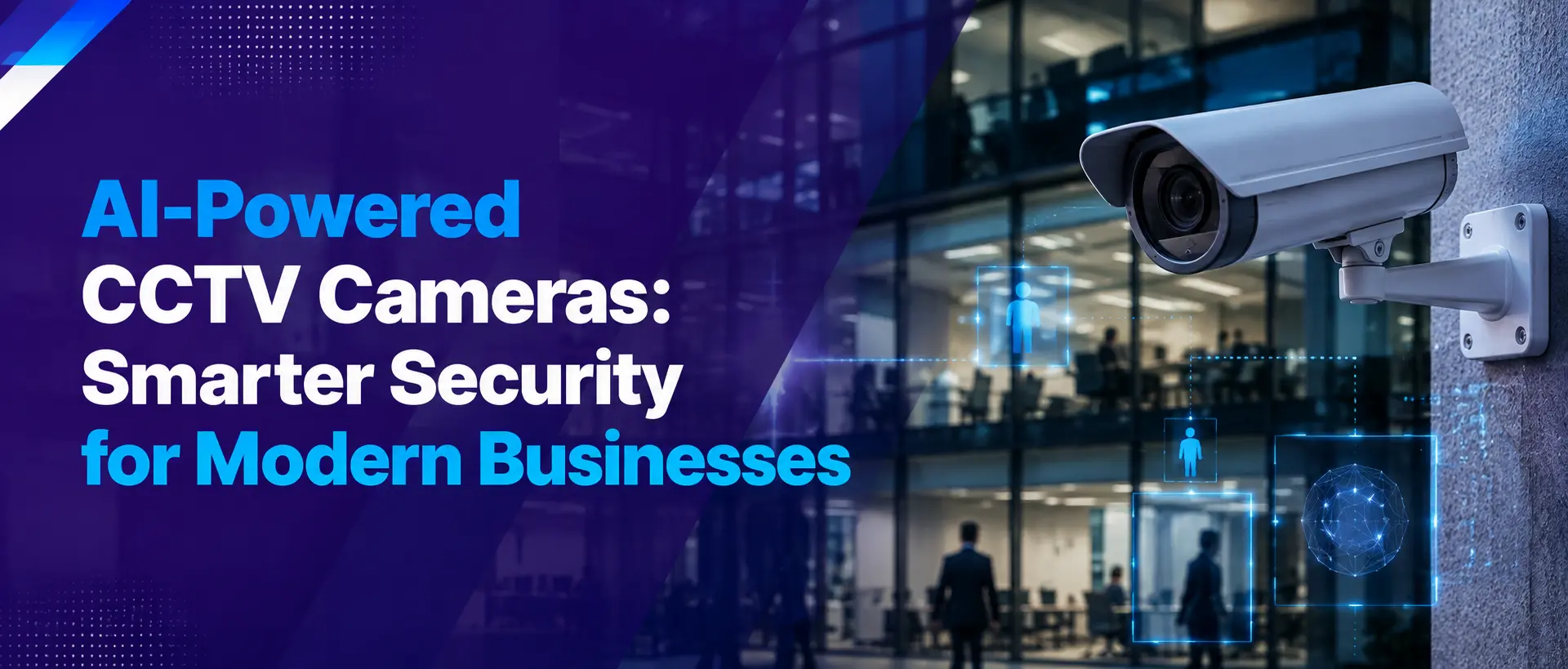
CCTV has long been one of the most important tools for protecting commercial premises. But modern businesses increasingly need more than cameras that simply record what happened. AI-powered CCTV cameras can analyse activity, identify potentially important events and generate intelligent alerts, helping security teams respond more quickly and make better use of recorded footage.
From offices and retail premises to warehouses, industrial sites and construction projects, artificial intelligence is changing the way businesses use video surveillance. Instead of relying entirely on someone watching multiple screens, AI-enabled CCTV can help identify people, vehicles, movement patterns and specific events that require attention.
In this guide, we explain how AI CCTV works, the features businesses should understand, where the technology can be useful and the important privacy considerations UK organisations should address before installing an intelligent CCTV system.
What Are AI-Powered CCTV Cameras?
AI-powered CCTV cameras are surveillance cameras equipped with intelligent video analytics. Depending on the system, the technology can analyse video footage in real time and identify predefined events or objects.
Traditional CCTV primarily captures and stores video. A person may then need to search through hours of recordings to find a particular incident.
AI CCTV adds an analytical layer to the surveillance system. It can help identify events such as a person entering a restricted area, a vehicle crossing a defined boundary or unusual movement in a monitored zone.
The exact capabilities depend on the camera, software, configuration and analytics platform. AI should therefore not be treated as a single feature. It is better understood as a collection of intelligent tools that can be configured around a business's security requirements.
How Does AI CCTV Technology Work?
An AI CCTV system captures video through one or more cameras. Intelligent software then analyses the video according to rules or detection models configured for the site.
For example, a business may configure a camera to monitor a loading area after working hours. If the system detects a person entering the defined zone, it may generate an alert for a designated security team or monitoring service.
Depending on the system, analysis can take place within the camera itself, on a local recording device or through a connected software platform.
This can reduce the need for security personnel to continuously watch every camera feed and allows attention to be focused on events that have been identified as potentially significant.
AI CCTV vs Traditional CCTV
Both traditional and AI-powered CCTV systems have an important role in business security. The difference is largely in how the footage is processed and used.
| Traditional CCTV | AI-Powered CCTV |
|---|---|
| Primarily records video | Can analyse video activity |
| Often relies on manual footage review | Can help identify relevant events automatically |
| Motion detection may trigger basic alerts | Can distinguish between different types of activity |
| Limited event classification | Supports intelligent video analytics |
| Useful for evidence and deterrence | Can support prevention, detection and investigation |
AI does not necessarily replace conventional CCTV. In many commercial installations, intelligent analytics are used alongside high-quality cameras, recording equipment, access control, intruder alarms and professional monitoring.
Key Features of AI-Powered CCTV
Not every AI CCTV camera offers the same functionality. Businesses should choose features based on their actual security risks rather than simply selecting the camera with the longest list of specifications.
1. Human Detection
Human detection can help distinguish people from other movement within a camera's field of view. This can be particularly useful for outdoor areas where trees, animals, weather or passing objects could otherwise create unnecessary alerts.
2. Vehicle Detection
Vehicle detection can identify vehicles entering or moving through defined areas. It can be useful for car parks, loading bays, industrial yards and commercial entrances.
3. Intrusion Detection
Intrusion detection allows a virtual area or boundary to be created within the camera view. If configured correctly, the system can generate an alert when activity occurs within a restricted zone.
4. Line-Crossing Detection
A virtual line can be established across an entrance, boundary or restricted passage. An alert can then be generated when a person or vehicle crosses the configured line.
5. Loitering Detection
Some systems can identify activity where a person remains within a defined area for longer than the configured period. This may be useful around entrances, restricted zones or external areas where prolonged presence could warrant investigation.
6. Object Detection
Depending on the system, intelligent analytics may identify specific objects or changes in a monitored area. This can help security teams locate relevant events more quickly.
7. Automatic Number Plate Recognition
ANPR can be used to capture and analyse vehicle registration information. It may be suitable for applications such as car parks, controlled vehicle entrances and specific commercial security requirements.
However, ANPR involves the processing of personal data in many circumstances, so businesses need to consider privacy, retention, access and transparency requirements before deployment.
Real-Time Smart Alerts
One of the biggest advantages of intelligent CCTV is the ability to create targeted alerts.
Instead of receiving an alert every time movement is detected, a properly configured AI system can focus on specific types of activity.
Examples include:
- A person entering a restricted area.
- A vehicle entering a secured yard outside permitted hours.
- Movement across a defined security boundary.
- Activity around a protected entrance.
- Unusual activity in an otherwise restricted zone.
Alerts can potentially be delivered through security software, mobile applications, control rooms or integrated monitoring platforms, depending on the system installed.
The objective should not be to generate as many alerts as possible. Effective CCTV design aims to produce useful alerts while reducing unnecessary notifications.
Benefits of AI CCTV for UK Businesses
Improved Threat Detection
Intelligent analytics can help identify potentially important events without requiring an operator to watch every camera continuously.
Faster Investigation
Searching through large amounts of footage can be time-consuming. Intelligent search and event classification can help security teams locate relevant recordings more efficiently.
Reduced False Alerts
Basic motion detection can trigger alerts caused by weather, shadows, animals or other environmental movement. Human and vehicle analytics can help make alerts more targeted.
Better Protection Outside Working Hours
Many commercial premises are empty overnight. Intelligent cameras can help monitor key areas and identify activity when there are fewer people available to observe the site.
Better Use of Security Staff
AI analytics can help security personnel concentrate on events that need attention rather than continuously monitoring every camera feed.
Scalable Security
As a business grows, it may add cameras, entrances, storage areas or additional premises. An appropriately designed intelligent CCTV platform can provide a scalable foundation for future security requirements.
AI CCTV for Offices
Offices can use intelligent CCTV to protect entrances, reception areas, car parks, server rooms, storage areas and other restricted locations.
AI analytics can be particularly useful where businesses need to monitor external entrances outside normal working hours without requiring someone to watch the camera feed continuously.
Businesses should be particularly careful when CCTV is used in workplaces. Monitoring employees should have a clear purpose and should not become excessive or disproportionate.
The Information Commissioner's Office highlights the need for organisations to consider privacy, lawful processing, transparency and appropriate safeguards when using CCTV. :contentReference[oaicite:0]{index=0}
For a broader office security approach, see our Office Security Checklist .
AI CCTV for Warehouses
Warehouses often have large areas to protect, multiple access points, loading bays and external yards. This makes intelligent video analytics particularly useful.
AI CCTV can help monitor:
- Loading and unloading areas
- Warehouse entrances
- Vehicle yards
- Perimeter boundaries
- Restricted storage areas
- Employee and contractor entrances
AI analytics can also help security teams identify specific events more quickly when an incident occurs.
For additional warehouse security measures, read our Warehouse Security Best Practices .
AI CCTV for Retail Businesses
Retail businesses face a combination of security challenges, including theft, unauthorised access, damage and incidents involving customers or staff.
AI-enabled CCTV can help retailers monitor entrances, exits, stockrooms, delivery areas and external spaces.
Intelligent search can also make it easier to investigate incidents after they occur. However, analytics should be configured for legitimate security purposes and used in accordance with applicable privacy and data protection requirements.
AI CCTV for Construction Sites
Construction sites can be difficult to secure because they are often temporary, exposed and contain valuable equipment and materials.
AI CCTV can help monitor site entrances, equipment storage areas, perimeter fencing and other vulnerable locations.
A combination of intelligent cameras, appropriate lighting, intruder alarms and remote monitoring can provide a stronger security strategy than relying on CCTV alone.
AI CCTV for Industrial and Commercial Premises
Industrial sites may have large outdoor areas, multiple buildings, vehicle movements and restricted zones.
Intelligent CCTV can be configured to monitor specific areas and help identify people or vehicles entering locations where access is restricted.
Depending on the site, AI CCTV can also work alongside:
- Intruder alarms
- Access control
- Video door entry
- Security lighting
- Remote monitoring
- Perimeter protection
AI CCTV and GDPR: What UK Businesses Need to Consider
Intelligent CCTV should not be treated as simply a technology purchase. If cameras capture identifiable people, businesses need to consider data protection obligations.
The ICO states that organisations using CCTV need to consider privacy and data protection, including why CCTV is being used, what areas are covered and how long footage is retained. :contentReference[oaicite:1]{index=1}
Have a Clear Purpose
Businesses should establish why surveillance is necessary and what security problem it is intended to address.
Consider Privacy
Cameras should not unnecessarily capture areas where people have a reasonable expectation of privacy.
Use Appropriate Signage
People should generally be informed when surveillance is taking place and provided with appropriate information about who operates the system and why it is being used.
Control Access to Footage
Recorded footage should be protected against unauthorised access, loss or inappropriate use.
Set Appropriate Retention Periods
Businesses should determine how long footage needs to be retained for their specific purpose rather than storing recordings indefinitely.
Consider a DPIA Where Appropriate
A Data Protection Impact Assessment may be required where surveillance is likely to result in a high risk to individuals. This is particularly important for more intrusive technologies or monitoring activities.
The ICO's current guidance also highlights additional considerations where AI, facial recognition, ANPR or other technologies process personal information. :contentReference[oaicite:2]{index=2}
This article is general information and should not be treated as legal advice. Businesses should assess their individual circumstances and obtain appropriate professional advice where necessary.
Does AI CCTV Mean Facial Recognition?
No. AI CCTV does not automatically mean facial recognition.
Many intelligent CCTV systems use analytics for purposes such as human detection, vehicle detection, line crossing and intrusion detection without attempting to identify individuals.
Facial recognition is a separate and more sensitive application. Where biometric data is used to identify individuals, additional data protection considerations apply.
Businesses should therefore avoid choosing facial recognition simply because it is available. The technology should be justified by a clearly defined business requirement and assessed for necessity, proportionality and privacy impact.
AI CCTV Installation: What Should Businesses Consider?
Buying advanced cameras is only one part of creating an effective CCTV system. Installation and configuration have a major impact on performance.
Camera Position
Cameras should be positioned to provide useful coverage while avoiding unnecessary views.
Lighting
Poor lighting can affect image quality and analytics performance. Night-time conditions should be considered during system design.
Network Infrastructure
IP CCTV systems depend on reliable network infrastructure. Businesses should consider bandwidth, network security and resilience.
Storage
The required storage capacity depends on factors including camera resolution, number of cameras, frame rate, compression and retention requirements.
Analytics Configuration
Intelligent features need to be configured around the actual site. Poorly configured analytics can produce unnecessary alerts and reduce the usefulness of the system.
Integration
Businesses should consider whether CCTV needs to integrate with access control, intruder alarms, monitoring services or other security systems.
How Much Does AI CCTV Cost?
There is no single price for an AI CCTV installation because every commercial site has different requirements.
Factors that can affect the total cost include:
- Number of cameras
- Camera resolution
- AI analytics required
- Indoor or outdoor installation
- Night-time requirements
- Network infrastructure
- Recording and storage requirements
- Remote monitoring
- Access control integration
- Installation complexity
- Maintenance and support
A professional security survey is usually the best starting point because it allows the system to be designed around the property's risks rather than selecting equipment based solely on specifications or price.
For businesses comparing CCTV investment options, our Commercial CCTV Installation Guide provides further information about commercial CCTV planning.
When Should a Business Upgrade to AI CCTV?
An upgrade may be worth considering if your existing CCTV system is no longer providing the level of visibility or functionality your business needs.
Common warning signs include:
- Your cameras regularly generate false motion alerts.
- Security staff spend too much time searching recorded footage.
- Important areas are poorly covered.
- Your cameras provide poor images at night.
- Your existing system cannot support intelligent analytics.
- You need better monitoring of vehicle movements.
- Your business has expanded to additional areas.
- Your CCTV system no longer integrates effectively with other security controls.
Upgrading does not always mean replacing every camera. Depending on the existing infrastructure, some systems may be upgraded or expanded strategically.
AI CCTV Maintenance
Intelligent CCTV still requires regular maintenance. AI features cannot compensate for dirty lenses, damaged cameras, poor network connectivity or failing storage equipment.
Regular maintenance should include checks of:
- Camera lenses
- Camera positioning
- Night-time image quality
- Recording equipment
- Network connectivity
- Storage capacity
- Analytics rules
- Alerts and notifications
- Remote access
- Firmware and security updates
Regular servicing can help identify problems before a business needs footage for an important security incident.
Common AI CCTV Mistakes Businesses Should Avoid
Choosing Technology Before Assessing the Site
The latest camera technology is not automatically the right solution. Start with the property's risks, vulnerable areas and security objectives.
Overusing Analytics
Enabling every available feature can create unnecessary alerts. Analytics should be selected and configured around genuine security requirements.
Ignoring Lighting
Even an advanced camera needs suitable environmental conditions. Lighting should be considered as part of the overall CCTV design.
Neglecting Cybersecurity
Network-connected CCTV should be properly protected. Default passwords, outdated firmware and poorly secured remote access can introduce avoidable risks.
Forgetting Privacy
Intelligent surveillance can process significant amounts of information. Privacy and data protection should be considered during system design rather than after installation.
Why Professional CCTV Installation Matters
A commercial CCTV system is only as effective as its design, installation and configuration.
Professional installation can help businesses determine the right camera locations, identify blind spots, configure analytics appropriately and integrate CCTV with other security measures.
A professional approach also makes it easier to plan future expansion, maintenance and system support.
If your business is considering a new commercial CCTV system or upgrading an existing installation, speak to Third Eye Security about your requirements.
Looking for AI-Powered CCTV for Your Business?
Intelligent CCTV can give businesses more than recorded footage. With the right cameras, analytics, installation and monitoring strategy, it can become an important part of a wider commercial security system.
Whether you operate an office, warehouse, retail premises, industrial site or construction project, Third Eye Security can help you assess your CCTV requirements and develop a security solution around your property.
Contact Third Eye Security today to discuss your CCTV installation or upgrade requirements.
Conclusion
AI-powered CCTV cameras are changing the way businesses approach video surveillance. Instead of simply recording events for later review, intelligent CCTV can help identify relevant activity, improve alerts and make security footage easier to use.
The most effective approach is not simply to buy the most advanced camera available. Businesses should start by identifying their security risks, deciding what needs to be monitored and then selecting cameras and analytics that support those objectives.
AI CCTV can be particularly valuable when combined with other security measures such as intruder alarms, access control, security lighting and professional monitoring.
For UK businesses, privacy and data protection should also be built into the system from the beginning. The ICO's guidance makes clear that organisations using CCTV need to consider necessity, privacy, transparency, security and how personal information is handled.
With the right design and professional installation, AI CCTV can become a powerful part of a modern business security strategy.